Text Classification
The foundational NLP task of assigning a predefined label or category to a given block of text.
Why Does This Exist?
The internet generates billions of text documents, emails, tweets, and reviews every day. Humans cannot read them all. We need automated systems to route customer support tickets to the correct department, flag toxic comments on social media, filter spam from our inboxes, and gauge whether product reviews are positive or negative.
Text Classification is the umbrella term for all of these tasks. It is the process of taking a sequence of text and assigning it one or more discrete labels from a predefined set.
Think of It Like This
Think of It Like This
Imagine a sorting facility at a post office.
Thousands of mixed letters come down the conveyor belt. A worker looks at the zip code on each envelope and tosses it into the correct bin: "New York", "California", or "Texas".
Text classification is the automated version of this worker. Instead of looking at a zip code, it reads the content of an email and tosses it into the "Spam" bin or the "Inbox" bin.
How It Actually Works
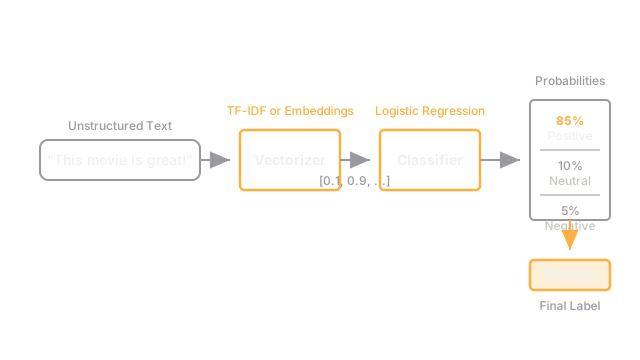
Regardless of whether you are using a 1990s Naive Bayes model or a modern Transformer, the text classification pipeline always follows the same basic architecture:
1. Vectorization
Because classifiers cannot perform math on strings, the text must first be converted into a numerical representation.
- Classical methods use Bag of Words or TF-IDF.
- Deep learning methods use Word2Vec, Sentence Embeddings, or Transformer contextual embeddings.
2. The Classifier
The numerical vector is fed into a classification algorithm.
- Naive Bayes and Logistic Regression are the historical baselines. They are incredibly fast, highly interpretable, and still win in low-data environments.
- Support Vector Machines (SVM) are mathematically excellent at drawing boundaries between classes in high-dimensional text spaces.
- Neural Networks (CNNs, RNNs, Transformers) learn complex hierarchical features, capturing sentiment and syntax that linear models miss.
3. The Output
The model outputs a probability distribution over the possible classes. A Softmax function ensures these probabilities sum to 1.0. The class with the highest probability is chosen as the final label.
Code
Here is a complete, production-ready classical text classification pipeline using scikit-learn. It predicts whether a movie review is positive or negative using TF-IDF and Logistic Regression.
from sklearn.feature_extraction.text import TfidfVectorizerfrom sklearn.linear_model import LogisticRegressionfrom sklearn.pipeline import make_pipeline
# 1. Our training datatraining_texts = [ "I absolutely loved this movie, fantastic acting!", "What a waste of time, terrible plot.", "The cinematography was beautiful and the story was engaging.", "Boring, dull, and completely unoriginal."]# 1 = Positive, 0 = Negativetraining_labels = [1, 0, 1, 0]
# 2. Build the pipeline (Vectorization -> Classification)# This prevents data leakage and makes inference a single function callmodel = make_pipeline( TfidfVectorizer(lowercase=True, stop_words='english'), LogisticRegression())
# 3. Train the modelmodel.fit(training_texts, training_labels)
# 4. Predict on novel textnew_reviews = [ "This was a fantastic experience.", "I fell asleep halfway through."]
predictions = model.predict(new_reviews)probabilities = model.predict_proba(new_reviews)
for text, pred, prob in zip(new_reviews, predictions, probabilities): label = "Positive" if pred == 1 else "Negative" confidence = prob[pred] print(f"[{label} - {confidence:.2f}] {text}") # -> [Positive - 0.69] This was a fantastic experience.# -> [Negative - 0.63] I fell asleep halfway through.Watch Out For
Class Imbalance.
If you are building a fraud detection classifier, 99.9% of your data will be "Not Fraud" and 0.1% will be "Fraud". If the model simply guesses "Not Fraud" every single time, it achieves 99.9% accuracy, but it is completely useless. You must evaluate text classifiers using metrics like F1-Score or Precision/Recall, never just raw Accuracy.
Multi-class vs. Multi-label.
These are different problems.
- Multi-class: The text belongs to exactly one category (e.g., classifying a news article as either Sports, Politics, OR Entertainment).
- Multi-label: The text can belong to multiple categories simultaneously (e.g., a movie can be Action, Sci-Fi, AND Comedy). You must configure your loss function and output layer differently depending on which problem you are solving.
The Quick Version
- Text classification assigns predefined labels to unstructured text.
- Common use cases include sentiment analysis, spam detection, and topic routing.
- The pipeline always involves converting text into numbers (vectorization) followed by a classification algorithm.
- Classical models like Naive Bayes and Logistic Regression remain highly effective baselines, while modern architectures like Transformers dominate complex tasks.