Automated Research
What if AI didn't just help humans do research, but actively hypothesized, conducted experiments, read the results, and wrote the scientific paper entirely on its own?
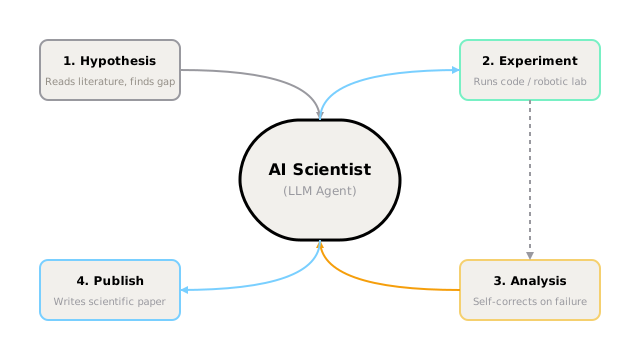
Why Does This Exist?
Historically, the scientific method has required human intellect at every step: reading prior literature, formulating a hypothesis, designing an experiment, running the experiment, analyzing data, and publishing the results.
"AI for Science" (like AlphaFold) gave scientists incredibly fast tools for the analysis step, but the human was still driving the car. Automated Research (sometimes called the "AI Scientist" paradigm) aims to automate the entire loop. If an AI agent can read papers, hypothesize, trigger robotic lab equipment, and write the final paper, scientific progress becomes software-scalable.
Think of It Like This
Traditional Science: You are a chef. You read a recipe book, decide you want to invent a new cake, mix the ingredients yourself, bake it, taste it, and write down the final recipe.
Automated Research: You own a fully robotic kitchen. You tell the head robot, "Invent a cake that tastes like strawberries but has zero calories." The robot reads 1,000 recipe books, creates 50 hypotheses, bakes 50 cakes using robotic arms, chemically analyzes them for flavor, writes a report on the best one, and hands you the recipe.
How It Actually Works
Automated research relies on connecting advanced Large Language Models (for reasoning) with specialized tools and environments.
1. Literature Review & Hypothesis Generation
The LLM Agent is given access to a vector database containing millions of scientific papers (e.g., PubMed, arXiv). It reads the cutting-edge literature, identifies a gap in human knowledge, and formulates a novel, testable hypothesis.
2. Experimental Design & Execution
The agent writes the code required to test the hypothesis.
- In computational science (like machine learning research), the agent literally writes the Python code, runs the training script on a GPU cluster, and waits for the results.
- In wet-lab science (like chemistry), the agent outputs instructions to a "Self-Driving Lab"—a physical robotics facility that autonomously mixes chemicals and runs assays based on the AI's API requests.
3. Iteration and Self-Correction
The experiment usually fails the first time. The agent reads the error logs or the negative lab results, updates its internal context, modifies the hypothesis or the code, and tries again. This loop runs 24/7 without human fatigue.
4. Paper Writing
Once a statistically significant result is found, the agent drafts a research paper, generates the data visualizations (charts and graphs), and formats it for publication.
Code
This pseudo-code demonstrates the autonomous scientific method.
def autonomous_research_loop(topic, agent, lab_api): # 1. Literature review and hypothesis literature = agent.search_arxiv(topic) hypothesis = agent.generate_novel_hypothesis(literature) success = False while not success: # 2. Design experiment experiment_code = agent.write_experiment_script(hypothesis) # 3. Execution (via computational sandbox or robotic lab) results = lab_api.run(experiment_code) # 4. Analysis and iteration if agent.analyze_significance(results) > 0.95: success = True else: hypothesis = agent.refine_hypothesis(results) # 5. Publication paper = agent.write_scientific_paper(hypothesis, results) return paperWatch Out For
The Evaluation Crisis
If an AI can generate 1,000 scientific papers a day, the human peer-review system will instantly collapse. We do not currently have a reliable way to automatically verify if an AI's novel scientific theory is actually true, or just highly plausible-sounding hallucination.
Safety and Dual-Use
An agent capable of autonomously inventing a cure for a virus is, fundamentally, also capable of autonomously inventing a new, highly lethal virus. Connecting autonomous hypothesizing agents to real-world robotic chemistry labs carries immense biosecurity risks.
The Quick Version
- Automated Research attempts to automate the entire scientific method, from hypothesis generation to paper writing.
- It relies on LLM Agents that can read literature, write experiment code, and interact with robotic "Self-Driving Labs" or computational clusters.
- The agent iteratively runs experiments, reads the failures, and self-corrects 24/7 without human intervention.
- While it promises to hyper-accelerate discovery, it poses massive challenges for peer review and biosecurity.