Contrastive Vision-Language Pretraining (CLIP)
To teach an AI that the word 'Dog' and a picture of a dog mean the exact same thing, you have to mathematically pull them together while simultaneously pushing them away from pictures of cats and cars.
Why Does This Exist?
In the early days of AI, if you wanted to train an image classifier to detect a dog, you had to manually gather 10,000 pictures of dogs and manually label them with the category [Class 1: Dog]. This supervised learning approach was extremely expensive and strictly limited the AI to the categories you specifically defined.
In 2021, OpenAI released CLIP (Contrastive Language-Image Pretraining), which completely broke this paradigm. Instead of using manual labels, CLIP learned by reading the internet. It downloaded 400 million images alongside their HTML alt-text captions. It used a clever mathematical trick (Contrastive Learning) to map the text and the images into the exact same "concept space."
CLIP became one of the most important foundation models in AI history, powering everything from Midjourney's text-to-image understanding to the visual reasoning inside GPT-4o.
Think of It Like This
The Magnetized Filing Cabinet
Imagine you have a giant, floating filing cabinet where physical distance represents meaning.
- You throw a photograph of a dog into the cabinet.
- You throw the sentence "A cute fluffy dog playing fetch" into the cabinet.
Because they are different file types (an image and a piece of paper), they naturally float to opposite ends of the room. Contrastive Learning attaches a magnet to both of them. It forcefully pulls the dog image and the dog sentence together, until they are touching. At the exact same time, it turns on a reverse-magnet (repulsion) that violently pushes the dog image away from the sentence "A fast red sports car."
Eventually, the room organizes itself purely by concept, completely ignoring whether the file is a picture or a string of text.
How It Actually Works
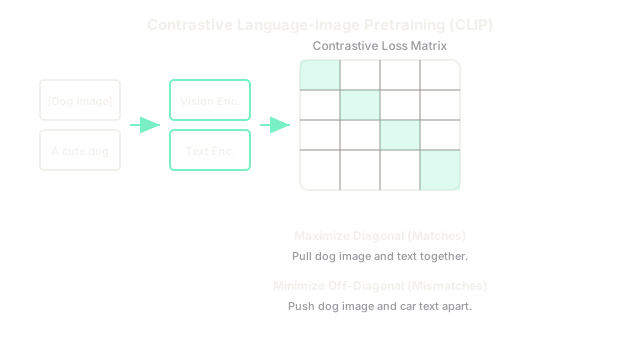
CLIP consists of two separate neural networks trained in parallel: a Vision Encoder (like a ResNet or Vision Transformer) and a Text Encoder (a Transformer).
1. Generating Embeddings
You feed a batch of images into the Vision Encoder. It outputs image embeddings (dense lists of numbers). You feed the corresponding text captions into the Text Encoder. It outputs text embeddings.
2. The Similarity Matrix
We now calculate the Cosine Similarity (the mathematical distance) between every single image and every single text caption in the batch. This creates an grid (a matrix). If (a standard batch size for CLIP), this matrix contains over 1 billion similarity scores.
3. Contrastive Loss (The Push and Pull)
The diagonal of the matrix represents the correct pairs (Image 1 and Text 1). The off-diagonal entries represent the incorrect pairs (Image 1 and Text 2, Image 1 and Text 3, etc.).
The Contrastive Loss function does two things simultaneously:
- Maximize the Diagonal: It updates the weights of both Encoders to make the embeddings of the correct pairs mathematically identical (pulling them together).
- Minimize the Off-Diagonal: It updates the weights to make the embeddings of the incorrect pairs mathematically opposite (pushing them apart).
By doing this across 400 million image-text pairs, the model slowly learns that a picture of a dog, the word "dog," the word "puppy," and a picture of a wolf all share the same region in mathematical space.
4. Zero-Shot Classification
Because CLIP understands concepts natively, it doesn't need to be fine-tuned. To classify an image, you just encode the image, and then encode 1,000 different text sentences like "A photo of a dog," "A photo of a cat," etc. Whichever text embedding has the highest cosine similarity to the image embedding is the winner. This is called Zero-Shot Classification.
Code
This pseudocode perfectly illustrates the elegance of the Contrastive Loss function. Notice how it uses a standard Cross-Entropy loss across the rows and columns of the similarity matrix.
import torchimport torch.nn.functional as F
def clip_contrastive_loss(image_encoder, text_encoder, images, text_tokens, temperature=0.07): """ Calculates the InfoNCE loss used to train CLIP. """ # 1. Get the embeddings for the batch # Shapes: (Batch_Size, Embedding_Dim) image_embeddings = image_encoder(images) text_embeddings = text_encoder(text_tokens) # Normalize the embeddings to unit length for Cosine Similarity image_embeddings = F.normalize(image_embeddings, p=2, dim=1) text_embeddings = F.normalize(text_embeddings, p=2, dim=1) # 2. Calculate the N x N similarity matrix # Shape: (Batch_Size, Batch_Size) logits = torch.matmul(image_embeddings, text_embeddings.T) / temperature # 3. Create the targets # Since the correct pairs are on the diagonal, the target for row 0 is column 0. # The target for row 1 is column 1, etc. batch_size = images.shape[0] targets = torch.arange(batch_size) # [0, 1, 2, ..., N] # 4. Calculate the Loss # We calculate the loss in both directions (Image-to-Text and Text-to-Image) loss_i2t = F.cross_entropy(logits, targets) loss_t2i = F.cross_entropy(logits.T, targets) # The final contrastive loss is the average of both directions return (loss_i2t + loss_t2i) / 2Watch Out For
The Typographic Attack
Because CLIP maps images and text into the exact same space, it is famously susceptible to "Typographic Attacks." If you take a picture of a Granny Smith apple, and tape a piece of paper to it that says "IPOD", CLIP will confidently classify the image as an iPod, completely ignoring the physical shape of the apple. It has learned that the literal text characters "I-P-O-D" in the image strongly match the text embedding for "iPod," overriding its visual understanding.
The Quick Version
- Training vision models used to require expensive, manual human labeling.
- CLIP (Contrastive Language-Image Pretraining) changed this by learning directly from billions of images and their noisy internet captions.
- It uses Contrastive Learning to pull matching image/text pairs together in mathematical space, while pushing mismatched pairs apart.
- This creates a unified "concept space" where the word "dog" and a picture of a dog share the same mathematical coordinates.
- Because it understands concepts, CLIP enables Zero-Shot Classification, allowing it to identify objects it was never explicitly trained to detect.