Multimodal Fusion
Humans don't just read text; we look at images, hear sounds, and combine all that sensory data in our brain to understand the world. Multimodal Fusion is how AI combines different types of data into a single neural thought.
Why Does This Exist?
For a long time, AI models were strictly unimodal. A Large Language Model (like GPT-3) could write a beautiful essay, but it was completely blind; it couldn't look at a photograph. A Vision Model (like ResNet) could perfectly identify a dog in a photo, but it couldn't hold a conversation about the dog's breed.
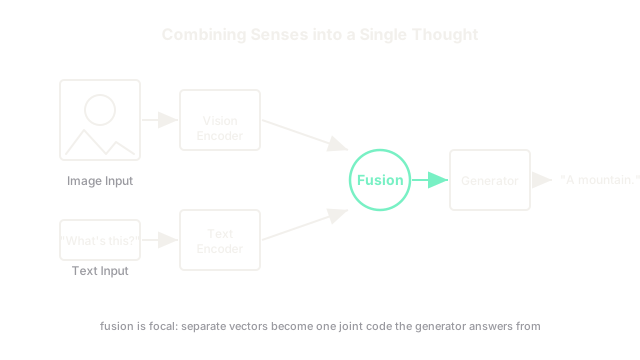
To build true Artificial General Intelligence (AGI), an AI needs to understand the world exactly like a human does: by looking, listening, and reading all at the same time. Multimodal Fusion is the architectural technique of taking two entirely different types of data (e.g., pixels from an image and letters from a text prompt) and fusing them together so the neural network can reason about both simultaneously.
Think of It Like This
The Blind and Deaf Detectives
Imagine two detectives trying to solve a crime.
- Detective A (The Vision Model): Is deaf but has perfect eyesight. They can watch the security footage, but they can't hear the suspects talking.
- Detective B (The Language Model): Is blind but has perfect hearing. They can read the transcripts and listen to the wiretaps, but they can't see the crime scene.
If they work in separate rooms, they will never solve the crime. Multimodal Fusion is the act of putting both detectives in the exact same room, allowing them to share their notes and combine their senses into a single, unified theory of the crime.
How It Actually Works
You can't just add a picture of a dog to the word "dog." Mathematically, they are entirely different shapes (a 3D matrix of pixels vs. a 1D sequence of integers). Fusion requires specialized mathematical operations.
1. Early Fusion (Token Level)
In Early Fusion, we smash the data together at the very beginning of the neural network. We take the image, chop it up into patches, and convert those patches into 1D embeddings. We take the text, and convert it into 1D embeddings. Because they are now the exact same mathematical shape, we can simply concatenate them into one giant list: [Image_Token_1, Image_Token_2, Text_Token_1, Text_Token_2].
We feed this giant list directly into a Transformer. The Transformer's Self-Attention mechanism naturally learns how the image tokens relate to the text tokens.
2. Late Fusion (Decision Level)
In Late Fusion, we keep the detectives in separate rooms until the very end. The Vision Model looks at the image and outputs a decision: "I am 90% sure this is a dog." The Language Model reads the text and outputs a decision: "Based on the text, the user is asking about a cat." A small, final neural network sits at the end, looks at the decisions from both models, and makes a final ruling. Late Fusion is very easy to build, but it misses out on complex nuance because the models can't share information while they are thinking.
3. Intermediate Fusion (Cross-Attention)
This is the most popular method in modern generative AI. We process the image through a Vision Encoder to get a rich visual representation. Then, while the Language Model is generating the text response word-by-word, we use a Cross-Attention layer. This allows the Language Model to constantly "peek" at the visual representation to help it decide what word to generate next.
Code
This pseudocode demonstrates a simple Intermediate Fusion technique using Cross-Attention, which is the backbone of many modern Vision-Language Models.
import torchimport torch.nn as nn
class MultimodalFusionModel(nn.Module): def __init__(self): super().__init__() self.vision_encoder = VisionTransformer() self.text_decoder = TransformerDecoder() def forward(self, image_pixels, text_prompt_tokens): # 1. The Vision Encoder analyzes the image # Output shape: (Batch, Num_Image_Patches, Hidden_Dim) visual_features = self.vision_encoder(image_pixels) # 2. The Text Decoder processes the text, but it is FUSED with the image # using Cross-Attention. # The Decoder says: "Based on the text I've seen so far, which parts of # the visual_features should I pay attention to?" output_logits = self.text_decoder( input_ids=text_prompt_tokens, encoder_hidden_states=visual_features # <-- FUSION HAPPENS HERE ) return output_logitsWatch Out For
The Modality Gap
When fusing text and images, neural networks often suffer from the "Modality Gap." Even if you map the word "Dog" and an image of a dog into the same mathematical space, the network will naturally cluster all the images together in one corner of the space, and all the text together in another corner, rather than clustering the concept of a dog together. Researchers have to use specialized Contrastive Learning techniques (like CLIP) to force the network to close this gap and truly align the modalities before fusion can work properly.
The Quick Version
- Standard AI models are unimodal (they can only see, OR they can only read).
- Multimodal Fusion is the mathematical process of combining different data types (like images and text) so a single AI can reason about them simultaneously.
- Early Fusion concatenates the raw tokens together before passing them into a Transformer.
- Late Fusion lets separate models make independent decisions and averages the results at the end.
- Intermediate Fusion (Cross-Attention) allows a text generator to dynamically "look" at the image features while it writes its response, which is the most powerful method used in modern Vision-Language Models.