Diffusion Language Models
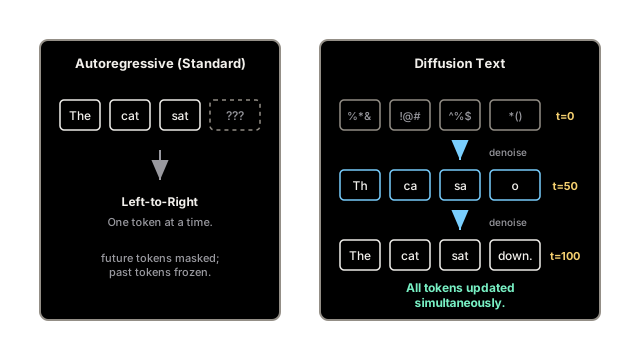
Standard LLMs generate text left-to-right, one word at a time. Diffusion Language Models generate the entire paragraph at once, starting with pure static and slowly refining it into coherent text.
Why Does This Exist?
Almost every modern text AI (like GPT-4, Claude, or LLaMA) is an autoregressive model. This means they generate text strictly left-to-right, one token at a time. The model predicts word #1, then uses word #1 to predict word #2, and so on.
This has two major limitations. First, it is fundamentally slow. You cannot parallelize generation; you must wait for word #99 to finish before you can compute word #100. Second, it suffers from "planning failures." If an autoregressive model writes itself into a corner in the first sentence, it cannot go back and rewrite it; it must awkwardly try to fix the logic in the second sentence.
Diffusion Language Models attempt to solve this by generating all the words simultaneously, similar to how image generators like Midjourney or DALL-E generate all the pixels of an image at once.
Think of It Like This
Autoregressive (Standard LLM): Like typing on a typewriter. You hit one key at a time. Once a letter is printed on the paper, it is permanent. If you realize halfway through the page that the introduction is wrong, you cannot fix it.
Diffusion Language Model: Like sculpting from a block of clay. You start with a massive, formless block (random noise). You don't carve it left-to-right. Instead, you look at the whole block, make a rough pass over the entire thing, and then do a second pass to add detail, continuously refining the entire sculpture simultaneously until the text emerges.
How It Actually Works
Applying diffusion to text is much harder than applying it to images. Images are continuous (a pixel can be slightly more red or slightly less red). Text is discrete (a word is either "cat" or "dog"; there is no such thing as a word that is 30% cat and 70% dog).
1. Continuous Latent Space
To solve the discrete text problem, Diffusion Language Models (like Plaid or Diffusion-LM) do not diffuse actual words. They embed the text into a continuous latent space (a high-dimensional mathematical representation of the concepts). The diffusion process happens entirely in this continuous math space.
2. The Forward Process (Adding Noise)
During training, the model takes a coherent sentence, embeds it into latent space, and gradually adds Gaussian noise over hundreds of steps until it becomes pure static.
3. The Reverse Process (Denoising)
The model learns to reverse this process. During inference (generation):
- It starts with a sequence of pure, random noise vectors.
- It applies the neural network to predict the noise and subtract it, refining the entire sequence simultaneously.
- It repeats this denoising step (e.g., 50 times).
- Finally, it "rounds" the continuous latent vectors back into the nearest discrete words in the vocabulary.
Advantages
- Controllability: Because the model generates the whole paragraph at once, you can easily enforce global constraints. For example, you can force the model to ensure the paragraph ends with a specific sentence, and the model will naturally mold the rest of the text to fit that ending (something autoregressive models struggle with).
- Parallel Generation: In theory, you can generate 1,000 words in the same amount of time it takes to generate 10 words, because the sequence length doesn't dictate the number of compute steps.
Code
This conceptual code highlights the difference between autoregressive and diffusion generation loops.
def generate_autoregressive(prompt, max_length): # Left-to-right, one token at a time current_text = prompt for _ in range(max_length): next_token = predict_next_token(current_text) current_text += next_token return current_text
def generate_diffusion(prompt, sequence_length, steps=50): # Start with a full sequence of random noise latent_sequence = generate_random_noise(sequence_length) # Refine the ENTIRE sequence simultaneously over N steps for step in range(steps): noise_prediction = model.predict_noise(latent_sequence, prompt) latent_sequence = remove_noise(latent_sequence, noise_prediction) # Convert the continuous math back to discrete words once at the very end final_text = decode_latents_to_words(latent_sequence) return final_textWatch Out For
Compute Inefficiency at Short Lengths
If you only want to generate a 5-word sentence, an autoregressive model is incredibly fast (it only takes 5 steps). A diffusion model still requires 50-100 denoising steps to generate that same 5-word sentence. Diffusion only becomes computationally efficient when generating very long sequences.
The Discretization Gap
Because the model diffuses in continuous space, the final step of "rounding" the math back to discrete words can introduce errors. The model might generate a latent vector that perfectly bridges two concepts, but when forced to pick a real English word, it picks the wrong one, breaking the grammar.
The Quick Version
- Standard LLMs are autoregressive: they generate text left-to-right, one word at a time, which is slow and prevents global planning.
- Diffusion Language Models generate the entire text sequence simultaneously, starting from random noise and iteratively refining it.
- Because text is discrete and diffusion requires continuous math, these models operate in a latent embedding space, only converting back to words at the very end.
- This allows for highly controllable text generation (e.g., forcing specific endings or structures) and potentially faster generation for very long documents.