Generative Media Evaluation
Evaluating a math model is easy: the answer is either right or wrong. Evaluating an image generator is incredibly hard: how do you mathematically prove that one picture of a sunset is 'more beautiful' than another?
Why Does This Exist?
In traditional Machine Learning, evaluation is objective. If you build a model to predict house prices, you simply compare the model's prediction to the actual sale price and calculate the error.
Generative AI produces art, music, and poetry. These outputs are deeply subjective. If Midjourney generates a picture of a "cyberpunk city," how do we know if it's "good"? Did it follow the prompt? Is the lighting realistic? Are there weird artifacts (like people with six fingers)?
Because researchers cannot sit and manually grade 10 million generated images every time they tweak a model's code, the industry had to invent automated mathematical formulas to proxy human taste, alongside massive crowdsourced "blind taste tests."
Think of It Like This
The Baking Competition
How do you grade a cake in a baking competition?
- Automated Metrics (The Chemistry Test): You put the cake in a centrifuge. You measure the moisture content, the sugar-to-flour ratio, and check for foodborne bacteria. This guarantees the cake is structurally sound, but it doesn't tell you if it tastes good.
- Human Evaluation (The Taste Test): You give the cake to three judges and ask them to rate the flavor on a scale of 1 to 10.
To truly evaluate Generative AI, you must use both the chemistry test (Automated Metrics) and the taste test (Human Evaluation).
How It Actually Works
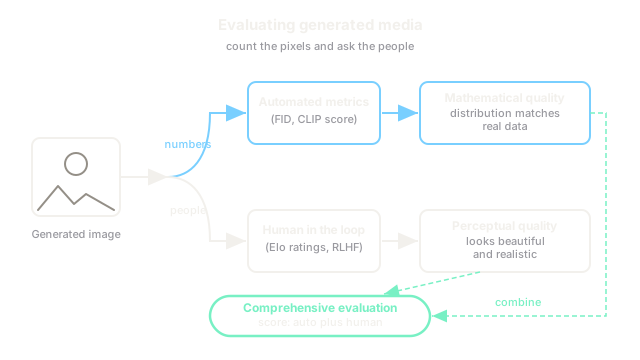
Evaluating an Image Generator usually involves two main automated metrics, followed by human preference ranking.
1. Fréchet Inception Distance (FID)
FID is the "Chemistry Test" for image quality. It measures how realistic the generated images are compared to real photographs. We take 10,000 real photos and 10,000 AI-generated photos. We pass all of them through a standard Vision model (InceptionNet) to extract their mathematical features. FID calculates the statistical distance between the "real" distribution and the "fake" distribution.
- A lower FID score means the AI images are statistically indistinguishable from real photos.
- However, FID is easily fooled. An AI that perfectly memorizes and regurgitates exact copies of the training data will get a perfect FID score, even though it's not actually generating anything new.
2. CLIP Score
FID only measures realism; it doesn't measure if the AI actually followed your instructions. CLIP Score measures text-image alignment. We generate an image using the prompt "A dog riding a skateboard." We pass both the image and the text through the CLIP model. If the resulting embeddings are mathematically close together (high cosine similarity), the CLIP Score is high. If the AI generated a picture of a cat, the CLIP score will be very low.
3. Human-in-the-Loop (Elo Ratings)
Because math formulas cannot measure "beauty" or "creativity," the ultimate evaluation for Generative Media is human preference. Platforms like Chatbot Arena use the Elo Rating System (the same system used to rank Chess players). A user types a prompt. Model A and Model B generate an image side-by-side. The user clicks whichever one looks better. If Model A beats Model B, it steals some of Model B's rating points. Over millions of blind match-ups, a definitive leaderboard of the most "beautiful" models emerges.
Code
This pseudocode shows how you might use CLIP Score in an automated testing pipeline to ensure your new diffusion model hasn't degraded in prompt adherence.
import torchimport torch.nn.functional as F
def evaluate_clip_score(clip_model, generated_image, original_text_prompt): """ Calculates how well the generated image matches the user's text prompt. """ # 1. Extract the visual features from the generated image image_embedding = clip_model.encode_image(generated_image) # 2. Extract the text features from the prompt text_embedding = clip_model.encode_text(original_text_prompt) # Normalize the vectors image_embedding = F.normalize(image_embedding, p=2, dim=-1) text_embedding = F.normalize(text_embedding, p=2, dim=-1) # 3. Calculate the Cosine Similarity (Dot Product) # A score of 1.0 means perfect alignment. # A score of 0.0 means the image has nothing to do with the text. clip_score = torch.sum(image_embedding * text_embedding) return clip_score.item()Watch Out For
The Goodhart's Law of FID
Goodhart's Law states: "When a measure becomes a target, it ceases to be a good measure." For years, AI researchers obsessively tuned their models solely to get a lower FID score so they could publish a paper claiming they beat the state-of-the-art. However, they soon realized that models with the lowest FID scores often produced images that looked incredibly boring, desaturated, and uncreative to actual human eyes. Today, the industry relies much more heavily on Human Preference (Elo) than pure mathematical metrics.
The Quick Version
- Evaluating Generative Media is difficult because art and beauty are subjective.
- FID (Fréchet Inception Distance) is an automated metric that measures realism by comparing the statistical distribution of generated images against real photographs.
- CLIP Score is an automated metric that measures prompt adherence by calculating the mathematical distance between the text prompt and the generated image.
- Because automated metrics fail to capture true aesthetic beauty, the gold standard for evaluation is Human Preference Ranking (Elo), where blind taste tests determine the ultimate winner.