Synthetic Media Detection
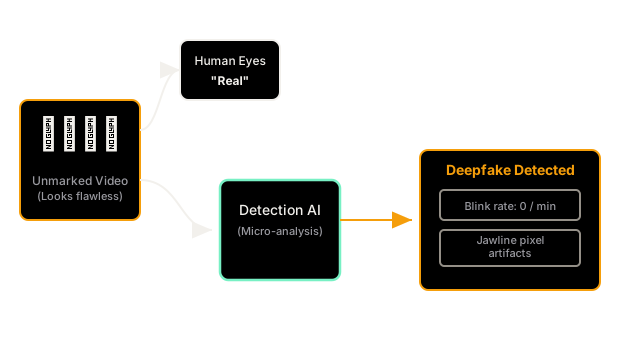
To identify unmarked deepfakes, specialized AI models analyze media for imperceptible biological errors (like unnatural blinking) or pixel-level inconsistencies that human eyes cannot see.
Why Does This Exist?
While Watermarking and Provenance are great for tracking images generated by responsible companies, they do nothing to stop a malicious actor who runs an open-source model on their own laptop to create a deepfake. A hostile actor will never intentionally watermark their own disinformation.
When we encounter media "in the wild" without a watermark, we need a way to determine if it is real. Synthetic Media Detection is the field of building AI models designed specifically to catch other AI models. It is a continuous arms race: as generators get better at making fakes, detectors must get better at finding the microscopic flaws left behind by the generation process.
Think of It Like This
An art appraiser spotting a forgery
If a master forger paints a fake Picasso, it might look perfect to the naked eye. An average person would easily be fooled.
But an expert art appraiser doesn't just look at the painting from a distance. They look at the painting under a microscope. They notice that the brushstrokes don't overlap in the correct chronological order, or they use chemical analysis to prove that the specific blue pigment used didn't exist when Picasso was alive.
Synthetic media detectors are digital appraisers. They ignore the "big picture" (which the AI generator has perfected) and zoom in on the microscopic digital brushstrokes (pixels, frequencies, and biology) where the generator makes mistakes.
How It Actually Works
Deepfake detectors look for two main categories of flaws: Biological/Physical Inconsistencies and Digital Artifacts.
1. Biological and Physical Inconsistencies
AI models don't actually understand physics or human biology; they just arrange pixels statistically. Because of this, they often fail at subtle physical laws:
- Blinking & Heart Rate: Early deepfake videos featured people who never blinked, because the training data mostly consisted of photos of people with their eyes open. Advanced detectors can even track micro-color changes in a speaker's face to measure their heart rate. If the heart rate in the video is completely erratic or flat, it's a deepfake.
- Lighting & Shadows: A deepfake might place a person's face in a scene, but the light reflecting in their corneas might not match the light sources in the background room.
- Hands and Teeth: Generative models famously struggle with exact symmetry and counting, often rendering hands with six fingers or mouths with a fused, continuous row of teeth.
2. Digital Artifacts
When a GAN or Diffusion model generates an image, it leaves behind mathematical traces in the frequency domain.
- Up-sampling Noise: Generators often create images at a low resolution and upscale them. This upscaling process leaves a distinct, checkerboard-like pattern in the image's frequency spectrum. While invisible in RGB pixel space, converting the image to the frequency domain (using a Fourier Transform) makes the AI's signature blindingly obvious to a detection model.
- Blending Boundaries: In "face-swap" deepfakes, an AI face is pasted onto a real actor's body. A CNN trained to detect deepfakes will look for sharp, unnatural transition boundaries along the jawline or neck where the synthetic pixels meet the real pixels.
Code
# A conceptual pipeline for a Deepfake Video Detectordef detect_deepfake(video_frames): # 1. Check for physical impossibilities (e.g., Blink Rate) blinks_per_minute = biological_model.analyze_blinks(video_frames) if blinks_per_minute < 5 or blinks_per_minute > 40: return "FAKE: Unnatural biological rhythms detected." # 2. Check for pixel blending artifacts around the face for frame in video_frames: face_region = extract_face(frame) # Use a specialized CNN to look for manipulation boundaries artifact_score = artifact_cnn.predict(face_region) if artifact_score > 0.95: return "FAKE: Face-swap blending artifacts detected." # 3. Check frequency domain (Fourier Transform) frequency_spectrum = compute_fft(video_frames[0]) if has_upsampling_checkerboard(frequency_spectrum): return "FAKE: Generative AI upsampling pattern detected." return "REAL: No synthetic artifacts found."Watch Out For
The Cat-and-Mouse Game
Any detector you build today will eventually be used to train tomorrow's generator. If a researcher publishes a paper saying, "We detect deepfakes by looking for mismatched corneal reflections," attackers will immediately update their loss functions to penalize mismatched reflections. The generator learns to fix the flaw, and the detector becomes obsolete.
Audio is much harder than video
While video deepfakes are still relatively easy for advanced models to catch (due to the complexity of syncing lighting, movement, and physics), audio deepfakes are incredibly difficult to detect. A 3-second clip of a cloned voice contains very few artifacts, making voice phishing (vishing) one of the most successful and dangerous forms of synthetic media today.
The Quick Version
- Synthetic Media Detection identifies unmarked deepfakes by looking for flaws that the AI generator missed.
- Detectors look for physical impossibilities (lack of blinking, weird shadows, six fingers) that prove the model doesn't understand the real world.
- They also analyze the frequency domain to find mathematical artifacts left behind by the AI's upscaling and pixel-generation processes.
- It is a continuous arms race: whenever a new detection technique is discovered, attackers use it to train better, undetectable fakes.