LoRA for Image Models
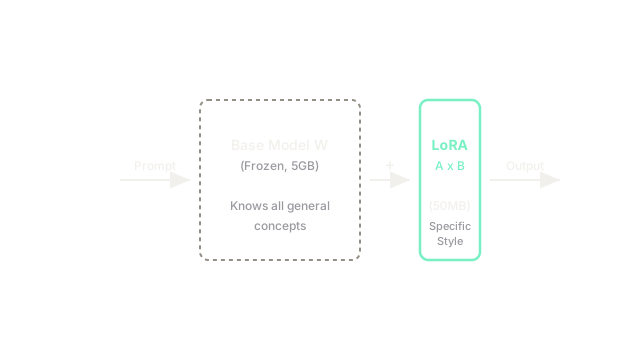
Instead of retraining a 5GB diffusion model to learn how to draw your pet dog, LoRA trains a tiny 50MB 'adapter' that sits on top of the base model, injecting the specific knowledge of your dog into the generation process.
Why Does This Exist?
Base diffusion models (like Stable Diffusion or Midjourney) know what a "dog" looks like. But if you prompt them for your specific dog, Buster, they will fail. They have never seen Buster.
Historically, if you wanted a model to learn a specific character, art style, or object, you had to fine-tune the entire model. Fine-tuning a 5-gigabyte model requires expensive GPUs, hours of time, and results in a brand-new 5GB file. If you wanted a model that knew Buster, and another model that knew the watercolor style of a specific artist, you now had 10GB of models sitting on your hard drive.
LoRA (Low-Rank Adaptation) was originally invented for Large Language Models, but the open-source image community adopted it with ferocious speed. LoRA allows you to train a tiny, 50MB "adapter" file that acts like a specialized brain implant for the base model. You can train a LoRA for Buster in 15 minutes on a cheap GPU, keep your original 5GB base model, and just load the 50MB Buster LoRA whenever you want him to appear in your images.
Think of It Like This
The Master Chef and the Recipe Cards
Imagine a Master Chef (the base Diffusion Model). The chef spent 10 years in culinary school learning every technique, how to chop vegetables, how to sear meat, and how to balance flavors. They know how to cook a "burger."
You want the chef to cook your grandmother's highly specific secret burger recipe.
- Full Fine-Tuning: You send the chef back to culinary school for a year to unlearn standard burgers and exclusively learn your grandmother's recipe. The chef is now permanently changed.
- LoRA: You hand the chef a tiny 3x5 index card with your grandmother's recipe on it. The chef uses their vast existing knowledge of how to cook, but perfectly follows the specific instructions on the card. When you want a normal burger again, you just take the card away.
How It Actually Works
The architecture of a diffusion model (usually a U-Net or DiT) is made up of dozens of massive weight matrices. Let's look at one specific matrix that has dimensions 10,000 x 10,000 (100 million parameters).
1. Freezing the Base Model
During LoRA training, we take the base model (the 5GB file) and completely freeze it. We calculate no gradients for it, and its weights will never change.
2. The Low-Rank Approximation
Instead of updating the massive 10,000 x 10,000 matrix , we inject two new, tiny matrices next to it: and .
- Matrix has dimensions 10,000 x (where is the "rank", a very small number like 4, 8, or 16).
- Matrix has dimensions x 10,000.
If , Matrix has 40,000 parameters and Matrix has 40,000 parameters. Together, that is 80,000 parameters. We just replaced 100,000,000 parameters with 80,000 parameters—a 99.9% reduction in training size!
When data flows through this layer, it goes through the frozen , and simultaneously goes through then . The results are added together: .
3. Training the LoRA
To train the LoRA for "Buster the Dog", you provide a small dataset of 15 to 30 photos of Buster. You pass the photos through the frozen model, but you only update the tiny and matrices. Because there are so few parameters, it trains incredibly fast and requires very little VRAM.
4. Swapping and Merging at Inference
Once training is done, you save just the and matrices. This is your 50MB .safetensors LoRA file.
At generation time, you can dynamically load the LoRA. You can even load multiple LoRAs at once! You can load the "Buster" LoRA at 80% strength, and a "Watercolor Style" LoRA at 50% strength, and the math simply adds them all into the base model weights at runtime.
Code
This pseudocode shows how a standard linear layer in a diffusion model is wrapped to support a LoRA adapter.
import torchimport torch.nn as nn
class LoRALinear(nn.Module): def __init__(self, original_linear_layer, rank=8, alpha=1.0): super().__init__() # 1. The massive original weights (Frozen) self.base_layer = original_linear_layer self.base_layer.weight.requires_grad = False in_features = original_linear_layer.in_features out_features = original_linear_layer.out_features # 2. The tiny LoRA matrices (Trainable) # Matrix A compresses the input down to the 'rank' self.lora_A = nn.Linear(in_features, rank, bias=False) # Matrix B expands it back to the output size self.lora_B = nn.Linear(rank, out_features, bias=False) # 3. Scaling factor to control LoRA strength self.scaling = alpha / rank # Initialize A to Gaussian, B to zero so starting state is identical to base model nn.init.normal_(self.lora_A.weight) nn.init.zeros_(self.lora_B.weight)
def forward(self, x): # Base model output base_output = self.base_layer(x) # LoRA output lora_output = self.lora_B(self.lora_A(x)) * self.scaling # Add them together return base_output + lora_outputWatch Out For
Concept Bleeding (Overfitting)
Because the and matrices are so small, they act as an extreme information bottleneck. If you train a LoRA on 20 pictures of your dog, and in every single picture your dog is sitting on grass, the LoRA will strongly associate the concept of "grass" with your dog. If you prompt "My dog on the moon," the LoRA might force the AI to draw grass on the moon. This is called concept bleeding, and it requires careful dataset curation (varying backgrounds and poses) to prevent.
The Quick Version
- Fine-tuning a massive 5GB diffusion model to learn a specific character or style is too slow, expensive, and storage-intensive for everyday use.
- LoRA freezes the base model and injects tiny "adapter" matrices into the layers.
- By compressing the updates through a low-dimensional bottleneck (the "Rank"), LoRA reduces the trainable parameters by 99%, allowing training on cheap consumer GPUs.
- The resulting LoRA file is typically 50MB to 100MB, making it incredibly easy to share online.
- At inference time, multiple LoRAs can be dynamically loaded, mixed, and scaled to combine different characters, clothing, and art styles seamlessly.