ControlNet and Spatial Conditioning
Text prompts are too vague to describe exactly where an arm should be or what shape a building should take. ControlNet allows you to use rigid spatial maps—like edge detection or depth maps—to strictly force the AI to follow a specific layout.
Why Does This Exist?
When Text-to-Image diffusion models like Stable Diffusion were released, they were magical but frustratingly stubborn. If you prompted "A man sitting on a chair," the model might draw the man facing left, right, slouching, or standing next to the chair. Text is simply too low-bandwidth to enforce strict spatial layouts.
If you are an architect, you don't want a "concept" of a modern house; you want the AI to render your specific CAD drawing. If you are an animator, you need the character's arm in an exact 45-degree pose. ControlNet solved this by introducing spatial conditioning. It allowed users to feed the AI an extra image—like a black-and-white sketch, a depth map, or a stick-figure pose—and forced the AI to generate a highly detailed image that perfectly adhered to that structural layout.
Think of It Like This
The Tracing Paper
Imagine you hire a brilliant but eccentric oil painter. If you just give them a prompt ("Paint a sci-fi city"), they will paint something beautiful, but the buildings will be wherever they want.
- Standard Diffusion: Giving the painter a text prompt and hoping for the best.
- ControlNet: You take a photograph of your hometown, run it through a photocopier to extract just the harsh black-and-white outlines, lay that outline on the painter's canvas, and say, "Paint a sci-fi city, but you are only allowed to paint inside these exact lines."
ControlNet forces the wildly creative AI to obey strict structural guardrails.
How It Actually Works
The genius of ControlNet isn't just that it takes in an extra image; it is how it trains the neural network to accept that image without destroying the billions of parameters already learned by the base model.
1. The Catastrophic Forgetting Problem
If you take a pre-trained Stable Diffusion U-Net and just modify the input layer to accept an edge-map alongside the text prompt, you have to retrain the model. When you retrain a massive model on a new task, it suffers from catastrophic forgetting—it forgets how to draw realistic lighting, textures, and faces, reducing it to a mess.
2. The Trainable Copy (Lock and Clone)
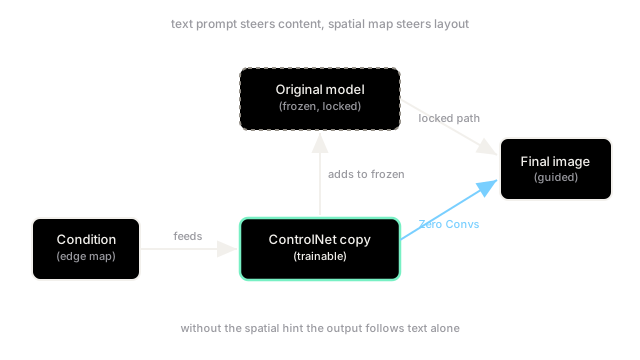
ControlNet solves this by locking the original U-Net entirely. Its weights are frozen; they cannot change. ControlNet then makes a complete clone of the "downsampling" half of the U-Net. This cloned half is made completely trainable. The new spatial condition (e.g., the edge map) is fed into this cloned, trainable network. Because the clone is separate, it learns how to interpret the edge map without messing up the original model's knowledge of what a photorealistic image looks like.
3. Zero Convolutions
How does the trainable clone communicate with the frozen original model? It uses a novel architecture trick called "Zero Convolutions." A Zero Convolution is simply a 1x1 convolutional layer where the weights and biases are initialized to exactly zero. Before training begins, passing data through a Zero Conv outputs zero. This means on Step 1 of training, the ControlNet clone adds literally nothing to the frozen model. The network behaves exactly like standard Stable Diffusion. As training progresses, the Zero Convs slowly learn to open up, carefully injecting the structural guidance into the frozen model only when it improves the output.
4. Types of Conditioning
Because of this robust architecture, you can train a ControlNet for almost any spatial condition:
- Canny Edge: Extracts hard outlines from a reference image.
- Depth Map: Extracts a 3D depth field (closer objects are white, further are black). Excellent for preserving volume.
- OpenPose: Extracts a skeleton of human joints. Forces the AI to generate people in exact poses.
- Segmentation: A color-coded map where blue = sky, red = building, green = grass.
Code
This pseudocode illustrates how the Zero Convolutions bridge the trainable ControlNet block to the frozen base model block.
import torchimport torch.nn as nn
class ZeroConv2d(nn.Module): def __init__(self, channels): super().__init__() self.conv = nn.Conv2d(channels, channels, kernel_size=1, padding=0) # Initialize weights and biases to EXACTLY zero nn.init.zeros_(self.conv.weight) nn.init.zeros_(self.conv.bias)
def forward(self, x): return self.conv(x)
def controlnet_forward_pass(x_noisy, condition_image, frozen_block, trainable_block, zero_conv): """ Demonstrates one block of a ControlNet architecture. """ # 1. The original frozen model processes the noisy image # (requires_grad is False) with torch.no_grad(): base_features = frozen_block(x_noisy) # 2. The trainable clone processes the noisy image + the condition # (requires_grad is True) control_features = trainable_block(x_noisy + condition_image) # 3. The Zero Conv bridges them safely # At initialization, injected_features is just 0 injected_features = zero_conv(control_features) # 4. Add the control signal to the base model's representation final_features = base_features + injected_features return final_featuresWatch Out For
Over-Conditioning
If you feed a highly detailed Canny edge map into ControlNet, it forces the AI to follow every single line. If your prompt is "An oil painting of a dog," but your edge map includes the sharp lines of a modern car in the background, the AI will try to paint a dog with car-like metal panels in the background. The AI cannot erase lines provided by the ControlNet. You must often pre-process or blur your conditioning images to give the AI room to be creative.
The Quick Version
- Text prompts alone are insufficient for enforcing strict spatial layouts or poses in AI image generation.
- ControlNet allows users to feed spatial maps (edges, depth, human poses) to strictly guide the output geometry.
- It prevents destroying the original model's quality by freezing the base model and creating a trainable clone.
- "Zero Convolutions" connect the clone to the base model, ensuring that at the start of training, the model behaves exactly like it did before, slowly learning to accept the new structural constraints.
- You can stack multiple ControlNets (e.g., a Depth map for the background + an OpenPose map for the character) to achieve total control over a generated scene.