Music Generation
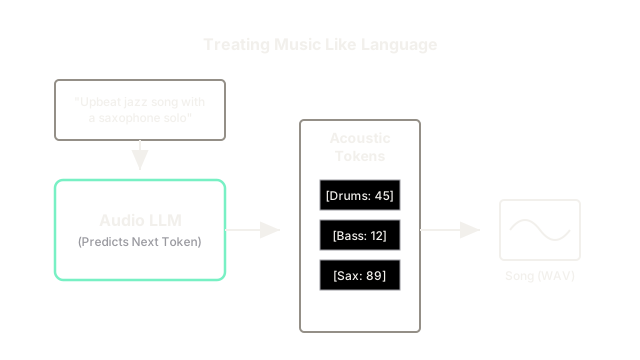
Generating a hit song with drums, bass, and vocals sounds impossible for an AI. But if you compress all those instruments into a single 'alphabet' of sounds, an AI can simply 'write' a song the same way ChatGPT writes an essay.
Why Does This Exist?
For a long time, AI could generate MIDI files (digital sheet music). It could tell a computer exactly when to play a C-Major chord on a digital piano. But generating actual audio—the raw, chaotic sound wave of a human singing over a distorted electric guitar and a heavy drum beat—seemed impossible. A 3-minute song contains 8 million audio samples. The structure of a song requires long-term memory: the chorus that plays at the 1-minute mark must sound exactly the same when it repeats at the 2-minute mark.
In 2023, models like Meta's MusicGen and Google's AudioLM proved that you could generate full-fidelity music using the exact same Transformer architecture that powers Large Language Models. By 2024, commercial systems like Suno and Udio were generating radio-quality, fully mixed songs with coherent vocals from a simple text prompt.
Think of It Like This
The Master Composer
Imagine an orchestra where the musicians don't have sheet music. Instead, they just stare at a giant teleprompter.
The teleprompter flashes a rapid sequence of commands:
[Kick Drum] [Bass Note C] [Vocal "Ah"] [Snare Drum]
The musicians instantly play those exact sounds.
An AI music generator is simply the computer writing the commands on that teleprompter. It doesn't actually "play" the instruments; it just predicts the exact sequence of acoustic commands required to make the song happen.
How It Actually Works
Almost all state-of-the-art music generators (Suno, Udio, MusicGen) use an LLM trained on discrete audio tokens.
1. The Audio Codec
We cannot train an LLM on raw audio waves. First, we take millions of hours of copyrighted music and pass them through a Neural Audio Codec (like EnCodec). This compresses the chaotic sound waves of the songs into a tight vocabulary of "Acoustic Tokens" (e.g., numbers from 1 to 1024). A specific token might represent "a snare drum hit combined with a high-pitched guitar squeal."
2. Conditioning the LLM
We train a massive Transformer (exactly like GPT-4) on these tokens. But if we just let it generate randomly, it would wander aimlessly from jazz to metal to classical. To control the generation, we condition the LLM. During training, we pair the song's acoustic tokens with a text description (e.g., "Upbeat 80s synth-pop with female vocals"). When you use Suno, you type in a text prompt. The LLM uses that text prompt as its starting context, forcing it to only predict acoustic tokens that match that specific genre.
3. Interleaving the Tokens (MusicGen)
Music is complex because multiple things happen at the exact same time. The drums play at the exact same millisecond the singer sings. Neural Codecs use multiple codebooks (layers of tokens) to capture this complexity (Residual Vector Quantization). The breakthrough of Meta's MusicGen was figuring out how to feed multiple layers of tokens into a single LLM simultaneously. By "interleaving" the tokens (predicting the broad drum sound, then immediately predicting the subtle vocal nuance, then moving to the next millisecond), the LLM can generate a rich, multi-layered audio file in a single pass.
Code
This pseudocode shows how a text-conditioned LLM generates a song by predicting multiple layers of acoustic tokens.
import torch
def generate_song(music_llm, codec_decoder, text_prompt, length_seconds=30): """ Generates a song using a text-conditioned Audio LLM. """ # 1. Convert the user's prompt into context for the LLM context = text_tokenizer.encode(text_prompt) # We will generate 75 tokens for every second of audio total_tokens = length_seconds * 75 generated_tokens = [] for _ in range(total_tokens): # 2. The LLM looks at the text prompt AND the song generated so far logits = music_llm(context, generated_tokens) # 3. Predict the next token (this token represents ALL instruments # playing at this exact millisecond) next_acoustic_token = sample(logits) generated_tokens.append(next_acoustic_token) # 4. We now have a list of e.g. 2,250 numbers. # Pass them through the Codec Decoder to turn them back into a WAV file. final_song_audio = codec_decoder.decode(generated_tokens) return final_song_audioWatch Out For
The Copyright Crisis
Unlike image generation (where an AI might occasionally draw a Mickey Mouse logo), music generation models have a severe tendency to memorize and regurgitate their training data. If you prompt an AI for "1990s grunge rock, male vocalist," the model might literally generate the exact audio of Nirvana's Smells Like Teen Spirit, complete with Kurt Cobain's exact voice. Because commercial models were trained on millions of copyrighted songs without permission, the entire music generation industry is currently facing massive existential lawsuits from the global record labels.
The Quick Version
- Generating raw audio is computationally impossible due to the sheer number of samples required.
- Music generation models solve this by passing all music through a Neural Audio Codec, compressing the songs into a sequence of discrete integer "tokens."
- A Large Language Model (similar to ChatGPT) is trained to predict the next token in the sequence.
- By providing a text prompt (e.g., "Jazz music"), the LLM is conditioned to only output tokens that assemble into a jazz song.
- Once the LLM finishes predicting the sequence of tokens, a Decoder turns those tokens back into a fully mixed, continuous physical sound wave.