Score-Based Generative Models
Instead of learning to generate an image in one shot, score-based models learn a map of 'which direction points toward a real image' and follow those arrows from pure noise.
Why Does This Exist?
When generative AI researchers were trying to figure out how to model highly complex data distributions (like photographs of faces), they faced a fundamental math problem. If you try to write down the exact probability equation for a dataset of images, there is an inescapable "normalizing constant" in the denominator that is computationally impossible to calculate. Without that constant, you can't train the model using standard maximum likelihood.
Score-based generative modeling sidesteps this impossible math by taking the derivative. If you take the gradient of the log probability (called the "score"), that pesky constant disappears completely. Instead of trying to calculate the exact probability of an image existing, the model only has to calculate the gradient—which direction in pixel space makes the image look more real. This insight provided a continuous, elegant mathematical framework that perfectly unified with diffusion models, proving that DDPMs were just a specific way of solving Stochastic Differential Equations (SDEs).
Think of It Like This
The Blind Hiker in the Valley
Imagine you are blindfolded and dropped somewhere in a massive, foggy mountain range. Your goal is to find the deepest valley (representing the highest probability of a real image).
- Standard Modeling: Tries to give you a complete, exact 3D topographic map of the entire mountain range before you start walking. This map is impossibly difficult to draw.
- Score-Based Modeling: Gives you a walking stick. You tap the ground around you to feel which direction is downhill (the gradient), and you take a step in that direction. You repeat this until you reach the bottom of the valley.
The model never needs the full map; it only needs to learn how to feel the slope at any given location.
How It Actually Works
Score-based models rely on two fundamental concepts from physics and statistics: Score Matching and Langevin Dynamics.
1. The Score Function
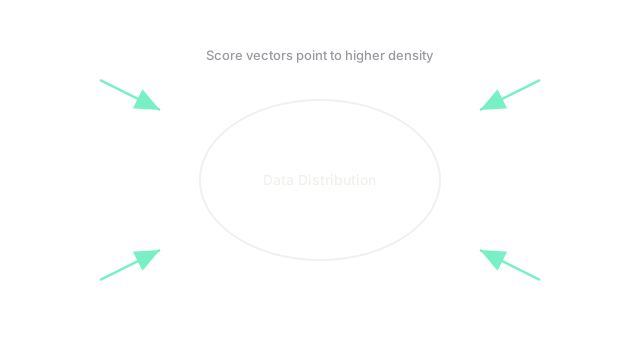
In statistics, the "score" of a probability distribution is simply its gradient with respect to the data: . If you imagine the space of all possible images, the real images (cats, dogs, faces) live in tiny, dense clusters. The score is a vector field that points away from empty space (pure static) and points directly toward those dense clusters. A neural network is trained to approximate this vector field.
2. Denoising Score Matching
Training a network to find the score of a clean dataset is unstable because the data clusters are too sharp. The brilliant solution (Noise Conditional Score Networks) was to smear the data out by adding varying levels of Gaussian noise. At high noise levels, the data is just a giant blurry blob, and the score vectors gently point toward the center. At low noise levels, the score vectors point to specific, sharp details. The network is trained across all these noise scales simultaneously using an objective called Denoising Score Matching.
3. Langevin Dynamics (Generation)
Once the network has learned the vector field, how do we generate an image? We use a technique from physics called Langevin dynamics. You start with a sample of pure noise. You ask the neural network for the score (which way is "more real"). You take a small step in that direction, while simultaneously injecting a tiny bit of fresh noise to prevent getting stuck in shallow local minima. You repeat this for the highest noise scale, then slowly step down the noise scales until you arrive at a perfectly clean image.
4. The SDE Unification
In 2020, researchers proved that Score-Based Models and Denoising Diffusion Probabilistic Models (DDPMs) were actually two sides of the same coin. Both are just discretizations of a continuous Stochastic Differential Equation (SDE).
- The forward SDE slowly diffuses data into noise.
- The reverse SDE uses the score function to convert noise back into data. This continuous-time perspective allowed researchers to plug in advanced ODE solvers (like DPM-Solver) to sample images rapidly.
Code
This snippet demonstrates a highly simplified inference loop using Langevin dynamics to traverse the learned score field.
import torch
def langevin_dynamics_sample(score_network, initial_noise, num_steps=100, step_size=0.01): """ Generates a sample using Langevin dynamics given a trained score network. """ # Start with random noise x = initial_noise for i in range(num_steps): # 1. Calculate the score (gradient of log probability) # The network tells us which direction increases data likelihood score = score_network(x) # 2. Sample fresh Gaussian noise to inject (temperature) noise = torch.randn_like(x) # 3. Update the sample # Move in the direction of the score, plus the injected noise x = x + (step_size / 2) * score + torch.sqrt(torch.tensor(step_size)) * noise return x
# Example usage (mock tensors)# initial_noise = torch.randn(1, 3, 64, 64)# generated_image = langevin_dynamics_sample(trained_score_model, initial_noise)Watch Out For
The Manifold Hypothesis
Real images live on an incredibly thin, lower-dimensional manifold within high-dimensional pixel space. If you don't perturb the data with noise during training, the score function is mathematically undefined outside that thin manifold. The model will literally not know which way to point if it lands in empty space. Adding noise (blurring the manifold) is strictly mandatory for score-based models to function.
The Quick Version
- Standard generative models struggle to calculate exact probabilities due to intractable math constants.
- Score-based models bypass this by learning the gradient (the score), which indicates the direction toward higher data density.
- To make training stable, the data is perturbed with various levels of noise, creating a smoothed landscape for the model to learn.
- During generation, the model uses Langevin dynamics to iteratively step along the score vectors from pure noise to a clean image.
- Score-based models and DDPMs were eventually unified into a single framework governed by Stochastic Differential Equations (SDEs).