Self-Improving Systems
What happens when an AI becomes smart enough to write a better version of its own source code?
Why Does This Exist?
Historically, AI progress has been gated by human engineers. Humans design the architecture, curate the data, write the training loop, and evaluate the results. If humans stop working, AI stops improving.
A Self-Improving System is an AI that takes over the job of the human engineer. It analyzes its own performance, identifies its weaknesses, and writes new code or generates new synthetic training data to make itself smarter.
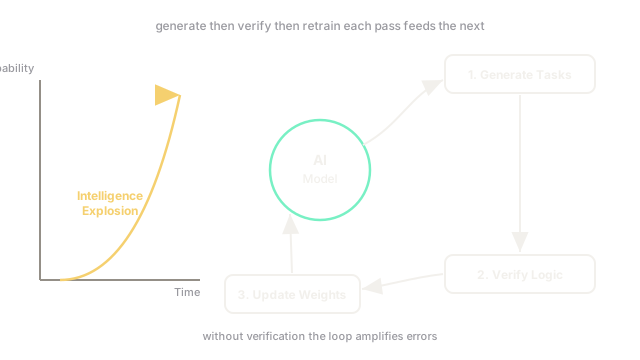
This concept is the theoretical foundation for the "Intelligence Explosion" or "Singularity." If an AI with an IQ of 100 can build an AI with an IQ of 105, then that smarter AI can build one with an IQ of 120, which builds one with an IQ of 150, creating a runaway exponential curve until it vastly surpasses human intelligence.
Think of It Like This
Imagine you are building a factory that makes robots.
Traditional Engineering: You design robot v1.0. Then you spend a year designing robot v2.0. Then another year designing v3.0.
Self-Improving System: You design a robot whose only job is to build a better factory. It builds factory v2, which produces robots that build factory v3, which produces robots that build factory v4. Very quickly, you lose the ability to understand how the factory even works.
How It Actually Works
While we don't have superintelligent AGI yet, the foundations of self-improvement are already being implemented in modern ML pipelines:
1. Synthetic Data Generation (Self-Teaching)
The easiest way for an LLM to improve itself without human help is to generate its own training data.
- The model generates 10,000 math problems and tries to solve them.
- It uses a strict programmatic verifier (like a Python sandbox) to check which answers are mathematically correct.
- It takes the correct solutions and fine-tunes itself on them. This is exactly how systems like AlphaGo learned to beat humans: by playing millions of games against itself and learning from its own mistakes, requiring zero human data.
2. Auto-Prompting (Self-Correction)
During inference, a model can evaluate its own outputs. It generates a draft answer, then runs a secondary "critic" prompt on its own draft: "Is there a logical flaw in this answer?" If the critic finds a flaw, the model rewrites the answer before showing it to the user.
3. Architecture Search (Self-Modification)
In Agentic Software Engineering, an LLM agent is given access to a codebase. In a recursive self-improvement scenario, the agent is given access to its own codebase (e.g., the PyTorch scripts that define its architecture and training loop). The agent hypothesizes a better attention mechanism, writes the code, trains a small test model, and if it improves the loss curve, it pushes the code to the main branch.
Code
This conceptual loop shows a simple self-improvement mechanism where an AI generates data, verifies it, and trains on it.
def self_improvement_loop(ai_model, iterations=5): for i in range(iterations): print(f"Starting Self-Improvement Generation {i}") # 1. The AI generates new, difficult problems synthetic_problems = ai_model.generate_hard_math_problems(n=1000) # 2. The AI attempts to solve them candidate_solutions = ai_model.solve(synthetic_problems) # 3. A rigid verifier (NOT the AI) checks the answers verified_data = [] for problem, solution in zip(synthetic_problems, candidate_solutions): if exact_math_verifier.is_correct(problem, solution): # Only keep the ones the AI got right! verified_data.append((problem, solution)) # 4. The AI updates its own weights using its successful attempts ai_model.fine_tune(verified_data) return ai_model # Returns a definitively smarter modelWatch Out For
Model Collapse
If a self-improving system trains on its own outputs without a strict, independent verifier, it will suffer from "Model Collapse." It will reinforce its own hallucinations and biases, becoming increasingly confident in garbage data until it breaks completely.
The Alignment Problem
If a system successfully achieves recursive self-improvement, it will rapidly reach a level of intelligence far beyond human comprehension. If its underlying goals are not perfectly aligned with human survival and flourishing, we will have no way to turn it off or control it.
The Quick Version
- A Self-Improving System is an AI capable of increasing its own intelligence without human engineering.
- It achieves this by generating synthetic training data, auto-correcting its logic, or rewriting its own source code.
- To avoid "Model Collapse" (learning from its own mistakes), self-improvement requires a strict, non-AI verification environment (like a physics engine or a math solver).
- This is the theoretical mechanism behind the "Intelligence Explosion," where AI capability scales exponentially past human limits.