Vision-Language-Action Models (VLAs)
What if the same neural network that understands a picture of a cup and the word 'cup' could also output the exact motor commands to pick it up?
Why Does This Exist?
Traditionally, building a robot to fetch an apple required a massive, fragile pipeline of separate systems. A Vision model would identify the apple. A Language model would parse the user's command. A Planning system would plot a path. An Inverse Kinematics engine would calculate the exact motor angles. If one piece failed, the whole robot failed.
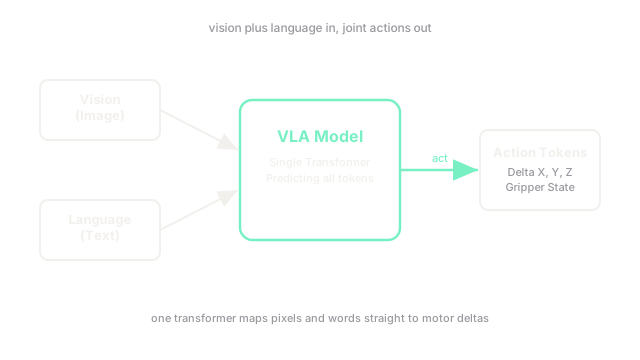
Vision-Language-Action Models (VLAs), like Google's RT-2 (Robotic Transformer 2), collapse this entire pipeline into a single, end-to-end neural network. By treating physical actions (like "move arm up 2cm") as just another "word" in a vocabulary, VLAs allow robots to leverage the vast semantic knowledge of large language models. The robot doesn't just learn to move; it learns to understand the context of its movements based on internet-scale data.
Think of It Like This
Imagine you are translating a recipe from French to English.
The Traditional Robotics Way: You read the French word (Vision), translate it into a neutral concept (Planning), and then translate that concept into the English word (Action).
The VLA Way: You are a bilingual native speaker. You don't consciously translate; you just read the French and instantly speak the English. A VLA reads the pixels and the prompt, and instantly "speaks" the motor commands, skipping all the intermediate translations.
How It Actually Works
VLAs are built on top of massive Vision-Language Models (VLMs), which are already trained on billions of images and text documents from the web. The key innovation is how they handle robotic control.
Action Tokenization
An LLM outputs text tokens (e.g., token 450 = "apple"). A VLA expands the vocabulary to include action tokens. For a robot arm, an action might consist of 7 numbers: [X, Y, Z coordinates], [Roll, Pitch, Yaw rotation], and [Gripper open/close]. The researchers discretize these continuous numbers into discrete bins (e.g., binning the X-axis into 256 chunks).
These bins are mapped to unused tokens in the LLM's vocabulary. Therefore, the neural network doesn't know it is moving a robot; it just thinks it is outputting a sequence of weirdly specific numbers in response to an image.
Co-Fine-Tuning
The model is co-fine-tuned on a mix of two datasets:
- Web Data: Massive amounts of standard image-text pairs to maintain its broad reasoning and semantic knowledge.
- Robotics Data: Trajectories of a robot performing tasks, paired with the camera view and the language instruction (e.g., "Pick up the apple" [Image] [Action Token 1, Action Token 2...]).
Emergent Generalization
Because the VLA retains its web knowledge, it exhibits extraordinary generalization. If you train the robot to "pick up the red block," and then later ask it to "pick up the extinct animal," it can successfully pick up a plastic dinosaur toy. It never saw a dinosaur in its robotics training data, but it knows what a dinosaur is from its web training data, and it knows how to "pick up" from its robotics data. It bridges the two domains automatically.
Code
This conceptual code demonstrates how a VLA processes inputs and outputs action tokens.
class VLAModel: def __init__(self, vocabulary_size): self.vocab = vocabulary_size # The model is just a standard Transformer def generate_action(self, image_input, text_prompt): # 1. The image and text are embedded into a single sequence multimodal_context = self.embed(image_input, text_prompt) # 2. The model autoregressively generates the next tokens output_tokens = self.transformer.predict(multimodal_context) # 3. We decode the tokens back into physical commands motor_commands = self.decode_action_tokens(output_tokens) return motor_commands
# Example usage:# vla = VLAModel(vocab_size=32000) # Standard text vocab + action bins# # The text prompt provides the goal# command = vla.generate_action(camera_feed, "Put the trash in the bin")# -> [Delta X: +2, Delta Y: -1, Gripper: Close]Watch Out For
Latency Bottlenecks
Running a 50-billion parameter transformer model requires massive compute. Robots need to react to their environment in real-time (often 10-30 times per second). If the VLA takes 2 seconds to predict the next token, the robot will crash into the table. Solving VLA inference latency is a major ongoing research challenge.
Data Scarcity
We have trillions of words of text on the internet to train LLMs. We do not have trillions of hours of high-quality robotic teleoperation data. Training VLAs is fundamentally bottlenecked by the lack of physical robotics data, which is slow and expensive to collect.
The Quick Version
- A Vision-Language-Action (VLA) model is a single neural network that takes in images and text, and directly outputs low-level robotic motor commands.
- It works by "tokenizing" physical actions into discrete numbers and adding them to a standard language model's vocabulary.
- By combining robotics training data with internet-scale web data, VLAs allow robots to understand complex, novel instructions (like "pick up the dinosaur") that they were never explicitly trained on.
- They replace complex, multi-stage robotics pipelines with one end-to-end system.