Visual Question Answering (VQA)
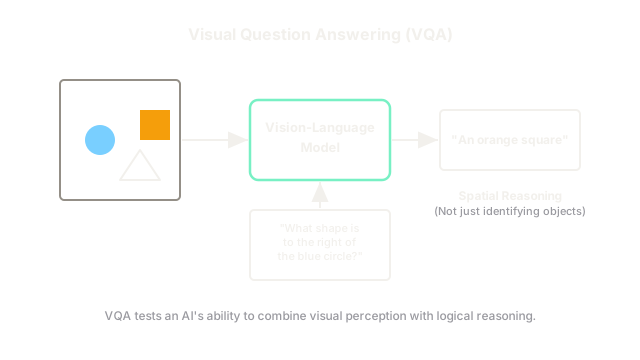
Instead of just asking an AI to 'identify the dog', VQA tests the AI's ability to reason. 'Is the dog in the picture likely to fall off the couch?' To answer this, the AI has to combine visual physics with logical language.
Why Does This Exist?
In the 2010s, Computer Vision models got incredibly good at Object Detection. If you showed a model a picture of a kitchen, it could perfectly draw a bounding box around the stove, the fridge, and the chef.
But if you asked that same model, "Is the stove turned on?" or "What is the chef cooking?", it would fail completely. Object Detection only tells you where things are. It does not provide any logical reasoning.
Visual Question Answering (VQA) is an AI task that bridges this gap. It requires an AI to take an image and a natural language question, and output a logical answer. VQA is considered one of the primary benchmarks for measuring true multimodal intelligence, because you cannot solve it without combining visual perception with common-sense reasoning.
Think of It Like This
The Physics Exam
Imagine taking a high-school physics exam. The test paper shows a diagram of a ball rolling down a ramp.
- Computer Vision is the ability to see the ink on the paper and recognize that it's a ball and a ramp.
- Language Modeling is the ability to read the text of the question: "Will the ball hit the wall?"
- Visual Question Answering is the cognitive process in your brain that combines the visual slope of the ramp with your logical understanding of gravity to arrive at the answer: "Yes."
How It Actually Works
Solving VQA requires a robust Vision-Language Model (VLM). The process generally involves three distinct reasoning steps.
1. Spatial Understanding (CLEVR)
Early VQA datasets, like the CLEVR benchmark, focused purely on spatial reasoning. Prompt: "What color is the cylinder that is to the left of the large red cube?" To answer this, the VLM's Vision Encoder must parse the 3D geometry of the scene. The LLM must then hold that geometry in its "working memory" while executing the logical steps: Find the red cube, move left, identify the object, output its color.
2. Common Sense Reasoning
Modern VQA requires the model to apply external knowledge that is not present in the image. Prompt (Image of a person holding an umbrella): "Is it likely to rain?" The VLM has to identify the umbrella, but it also has to retrieve the common-sense fact from its language training that "umbrellas are used when it rains" to deduce the correct answer.
3. OCR and Text Reasoning (TextVQA)
Many real-world images contain text (street signs, t-shirts, billboards). Prompt (Image of a storefront): "What time does this store close on Sundays?" The VLM must visually read the small text on the glass door, understand the tabular layout of the opening hours, map the word "Sunday" to the correct row, and extract the time.
Code
This pseudocode shows how a typical VQA pipeline is used in production applications, often acting as a high-level router for visual data.
def vqa_safety_check(vlm_model, security_camera_frame): """ Uses VQA to perform complex logical checks that standard object detectors cannot handle. """ # Ask a complex, logical question about the scene question = "Is the worker in this image wearing both a hard hat AND safety goggles?" # The VLM processes both the image and the complex logical query answer = vlm_model.generate(image=security_camera_frame, prompt=question) if "no" in answer.lower(): trigger_safety_alarm() return answerWatch Out For
The Yes/No Bias
VQA models are notorious for suffering from dataset bias. In many training datasets, questions that begin with "Is there a..." (e.g., "Is there a clock in the room?") have "Yes" as the answer 80% of the time. If an early VQA model was unsure, it would just guess "Yes" and be right 80% of the time, appearing much smarter than it actually was. Modern VQA benchmarks intentionally balance their questions to prevent models from "cheating" by relying purely on language statistics.
The Quick Version
- Standard Computer Vision models can identify objects (e.g., drawing a box around a car), but they cannot reason about them.
- Visual Question Answering (VQA) requires an AI to answer complex logical questions about an image.
- VQA tests an AI's ability to perform Spatial Reasoning (understanding left/right/behind), Common Sense Reasoning (inferring why an object is there), and Text Reading (parsing signs and labels in the image).
- It is one of the most important benchmarks used to evaluate the intelligence of modern Vision-Language Models (VLMs) like GPT-4o.