Whisper Architecture
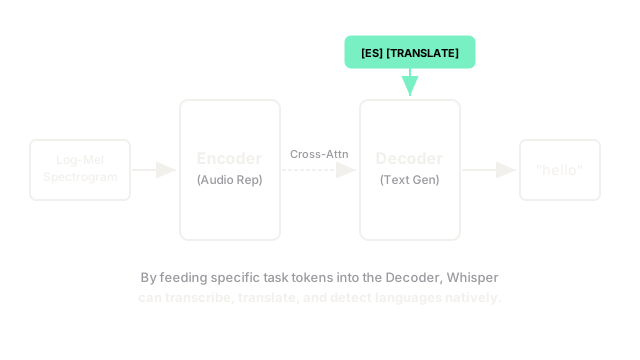
Instead of building separate AI models for English transcription, Spanish translation, and Japanese dictation, Whisper is a single massive Transformer that uses special 'Task Tokens' to switch its brain between transcribing and translating on the fly.
Why Does This Exist?
For years, speech recognition systems were highly specialized. If you wanted to transcribe English audio, you trained an English ASR model. If you wanted to translate that text to Spanish, you passed the text to a separate Machine Translation model. If the speaker switched to French halfway through the audio, the English ASR model would fail catastrophically.
In 2022, OpenAI released Whisper. It fundamentally changed the audio landscape by proving that you don't need a complex pipeline of specialized, fragile models. By treating speech recognition exactly like a Large Language Model translation task, Whisper can natively ingest audio in almost any language, automatically detect the language, transcribe it, and translate it to English—all within a single, unified neural network.
Think of It Like This
The UN Translator
Imagine a highly skilled translator working at the United Nations.
- Traditional Pipelines: You have one person who only knows how to write down phonetic Japanese sounds. They hand their paper to a second person, who only knows how to translate written Japanese into written English.
- Whisper: You have one UN translator who is fluent in 99 languages. You hand them an audio tape and a sticky note that says "[Japanese] [Translate]". They listen to the tape and immediately write the English translation. If the sticky note says "[Spanish] [Transcribe]", they listen and write the Spanish text.
Whisper changes its behavior based entirely on the instruction "tokens" it is fed at the start.
How It Actually Works
Whisper uses a standard, vanilla Encoder-Decoder Transformer architecture. This is the exact same architecture as the original 2017 "Attention Is All You Need" paper, applied to audio.
1. The Audio Encoder
The raw audio waveform is converted into a Log-Mel Spectrogram (an image of the frequencies). This spectrogram is sliced into patches (much like a Vision Transformer) and fed into the Encoder. The Encoder uses Self-Attention to analyze the entire 30-second audio clip globally. It figures out the phonemes, the intonation, and the acoustic features, outputting a rich mathematical representation of what was spoken.
2. The Text Decoder
The Decoder is an autoregressive language model (like GPT). Its job is to generate text, one word at a time. However, it doesn't just generate text randomly. It uses a mechanism called Cross-Attention. While generating the text, it constantly looks over at the Encoder's output to make sure the text perfectly matches the audio representation. This Sequence-to-Sequence approach naturally solves the alignment problem, completely eliminating the need for complex CTC Loss algorithms.
3. Task Tokens (The Magic)
How does the single Decoder know whether to transcribe French to French, or translate French to English?
Before the Decoder generates the first word of the text, we feed it a sequence of specialized context tokens.
A prompt might look like this: <|startoftranscript|> <|fr|> <|translate|> <|notimestamps|>
<|fr|>: Tells the model the audio is in French (or forces it to auto-detect).<|translate|>: Tells the model to output English text instead of French text.<|notimestamps|>: Tells the model to just output raw text, rather than inserting SRT subtitle timestamps.
Because Whisper was trained on 680,000 hours of multilingual audio using these exact tokens, it learned to seamlessly switch its internal routing based entirely on the prompt.
Code
This pseudocode illustrates how the Encoder-Decoder interacts and how the prompt tokens steer the autoregressive generation.
import torch
def whisper_generate(encoder, decoder, audio_spectrogram, task="transcribe", language="en"): """ Demonstrates the inference loop of the Whisper architecture. """ # 1. The Encoder processes the entire 30-second audio clip once # audio_features shape: (Batch, Audio_Sequence_Length, Hidden_Dim) audio_features = encoder(audio_spectrogram) # 2. Prepare the task tokens to steer the Decoder # e.g., [<|start|>, <|en|>, <|transcribe|>, <|notimestamps|>] decoder_input_tokens = build_prompt(language, task) # 3. Autoregressive Generation Loop for _ in range(MAX_LENGTH): # The Decoder looks at the tokens generated so far (Self-Attention) # AND it looks at the audio_features from the Encoder (Cross-Attention) logits = decoder(decoder_input_tokens, cross_attention_context=audio_features) # Predict the next token (e.g., the word "Hello") next_token = torch.argmax(logits[:, -1, :], dim=-1) # Append it to the sequence and repeat decoder_input_tokens.append(next_token) if next_token == END_OF_TRANSCRIPT_TOKEN: break return decode_to_text(decoder_input_tokens)Watch Out For
Hallucinations During Silence
Because the Whisper Decoder is fundamentally a Language Model (like GPT), it wants to generate text. If you feed Whisper a 30-second audio clip of pure silence or background static, the Cross-Attention mechanism won't find any speech. Instead of outputting nothing, the Decoder will sometimes rely entirely on its Language Model training and wildly hallucinate full paragraphs of text (often repeating phrases like "Thank you for watching") just to satisfy its urge to predict the next word.
The Quick Version
- Before Whisper, speech pipelines required separate, specialized models for language detection, transcription, and translation.
- Whisper unifies these tasks using a standard Encoder-Decoder Transformer architecture.
- The Encoder analyzes the audio spectrogram globally. The Decoder generates text autoregressively while using Cross-Attention to look at the audio.
- Whisper is steered entirely by "Task Tokens" injected at the start of generation (e.g., telling it to translate instead of transcribe).
- Because it relies on a powerful Language Model decoder, it rarely makes phonetic spelling mistakes (a common flaw in CTC models), but it is prone to hallucinating text during long periods of audio silence.