Speaker Diarization
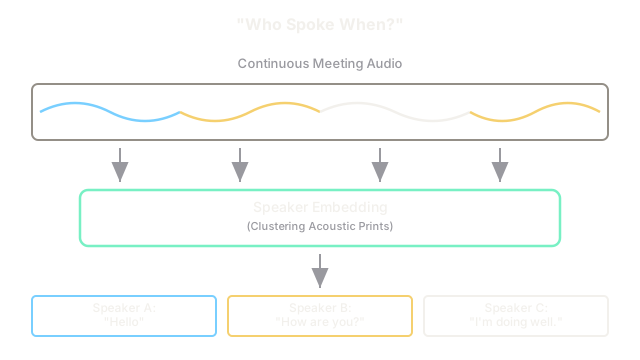
When recording a meeting with five people, speech recognition just spits out a giant wall of text. Speaker Diarization is the AI process of analyzing the acoustic fingerprints of the voices to label exactly who spoke when.
Why Does This Exist?
If you use a transcription model like Whisper on a 1-hour podcast recording featuring three different hosts, the model will output a perfect, massive block of text. However, you will have absolutely no idea who said what. Whisper just transcribes words; it does not track identities.
Speaker Diarization is the process of partitioning an audio stream into homogeneous segments according to the speaker identity. It is what allows Zoom, Teams, and podcast editing software to automatically label transcripts with "Speaker 1," "Speaker 2," and "Speaker 3."
Think of It Like This
The Blindfolded Detective
Imagine a blindfolded detective sitting in a room where three people are arguing. The detective writes down every word they hear (Speech Recognition). However, to figure out who is talking, the detective has to actively focus on the sound of the voices (Diarization). "Okay, the deep, raspy voice is speaking now. Now the high-pitched voice interrupted. Now the deep, raspy voice is back." Even without knowing their names, the detective can group the sentences by the acoustic signature of the vocal cords.
How It Actually Works
Diarization is typically run as a completely separate pipeline alongside Speech Recognition. It generally involves three steps:
1. Voice Activity Detection (VAD)
Before figuring out who is speaking, the model needs to figure out if anyone is speaking. The VAD algorithm scans the audio and chops out all the silence, background noise, and microphone static. It leaves behind only the segments that contain human speech.
2. Speaker Embedding (The Acoustic Fingerprint)
The remaining speech audio is chopped into tiny 1-second chunks. Each chunk is passed through a specialized neural network (historically called an x-vector or d-vector model). This network ignores the actual words being spoken. Instead, it extracts the biometric features of the vocal tract—pitch, resonance, and timbre—and outputs a dense vector (an embedding). If two chunks of audio were spoken by the same person, their embeddings will be mathematically very close together, even if one chunk is them laughing and the other is them whispering.
3. Clustering
Now we have hundreds of 1-second embeddings. We don't know how many people are in the meeting, and we don't know who they are. We use an unsupervised machine learning algorithm (like K-Means or Spectral Clustering) to group the embeddings. The algorithm might find that all the embeddings naturally form three distinct clusters. It labels these clusters "Speaker A," "Speaker B," and "Speaker C." Finally, these labels are merged with the text transcript based on the timestamps.
Code
This pseudocode shows how clustering is used to group the acoustic embeddings without knowing how many speakers there are in advance.
import numpy as npfrom sklearn.cluster import AgglomerativeClustering
def diarize_audio(audio_chunks, embedding_model): """ Groups audio chunks by speaker identity. """ embeddings = [] # 1. Extract the acoustic fingerprint for every 1-second chunk for chunk in audio_chunks: # The embedding is just a list of numbers, e.g., [0.4, -1.2, 0.8...] fingerprint = embedding_model.extract_features(chunk) embeddings.append(fingerprint) # 2. Cluster the embeddings # We use a clustering algorithm that doesn't require us to know the # number of speakers in advance. It groups them based on a distance threshold. clusterer = AgglomerativeClustering( n_clusters=None, distance_threshold=1.5 # If two voices are further apart than this, they are different people ) # 3. Get the labels (e.g., [0, 0, 0, 1, 1, 0, 2, 2]) # 0 = Speaker A, 1 = Speaker B, 2 = Speaker C speaker_labels = clusterer.fit_predict(embeddings) return speaker_labelsWatch Out For
The Overlapping Speech Problem
The biggest failure point of Speaker Diarization is when two people talk over each other. If a 1-second chunk of audio contains Speaker A and Speaker B arguing simultaneously, the embedding model gets confused and usually outputs a fingerprint that sits exactly halfway between them. The clustering algorithm might misclassify this as a brand-new "Speaker C." Modern advanced diarization systems use separate "Overlap Detection" models to flag these specific moments and handle them differently.
The Quick Version
- Standard Speech Recognition only transcribes words; it does not know who is speaking.
- Speaker Diarization solves the "who spoke when" problem.
- It chops the audio into tiny pieces and uses a neural network to extract the biometric "acoustic fingerprint" of the voice, ignoring the words.
- It uses unsupervised clustering algorithms to group similar acoustic fingerprints together, automatically identifying the number of unique speakers in the recording.
- It is the core technology behind auto-labeled transcripts in Zoom, Teams, and automated podcast editing tools.