Fixed Points
Where motion stops or repeats itself: the equilibria everything else organizes around, found by setting change to zero and tested for pull.
Why Does This Exist?
Training converges to parameters that reproduce themselves under the update; markets rest at prices that clear; processors settle at temperatures that balance heat. Each is a fixed point: for flows, for maps. Existence asks whether one must be there (Brouwer, Banach), computation asks how to land on it (iteration, Newton), and stability asks whether landing sticks or slides off. This page finds and types them; verdicts on attraction use stability with certificates in Lyapunov, and the contraction engine is in contraction mappings.
The one idea you need first
Continuous flow: solve . Discrete map: solve , equivalently . Attraction is separate from existence: a point can exist and repel, in which case iteration never finds it without help.
Think of It Like This
Thermostats, echoes, and ruts
A thermostat set to 20 in a 20-degree room does nothing: the room maps to itself. Shout in a canyon and the echo returns your voice shifted; the one pitch that returns unchanged is the canyon's fixed tone. A dirt road's ruts steer wheels into themselves: the rut bottom is an attracting fixed point of steering, while the crown between ruts is a repelling one that throws wheels either way.
Iteration is driving with loose hands: start anywhere and the ruts pull you in, but only into attracting ruts. Repelling crowns exist just as really, yet no amount of relaxed driving finds them: you must place the wheel exactly and hold it.
Where the analogy stops: real fixed-point theorems certify existence from shape (contraction, continuity on a ball) rather than road feel.
How It Actually Works
Flows. Solve (often via nullcline crossings in the plane). Linearize: eigenvalues vote attract or repel. Multiple isolated points each own a basin divided by separatrices.
Maps. Iterate . Banach guarantees convergence from anywhere when contracts (, ) on complete space, with error shrinking geometrically. Newton's method converges quadratically near simple roots but needs good starts.
Typing. Attracting (neighbours converge), repelling (neighbours flee), semi-stable (one side each), and non-hyperbolic (linearization silent, higher orders decide).
Worked example
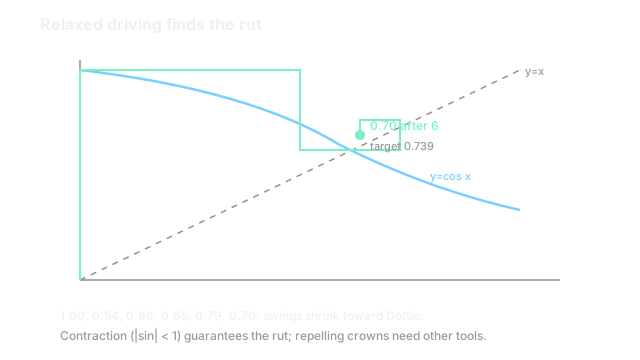
Cosine map from (radians). The fixed point solves : the Dottie number .
Iterate: , , , , , . Six steps bracket within , oscillating around it with shrinking swings: near the point, so cosine contracts and Banach applies. Contrast : fixed points (repelling, ) and (attracting, ): existence pairs with opposite stability on one line.
Watch Out For
Iterating toward a repeller and reading divergence as a bug
Plain iteration flees repelling fixed points exponentially: the point exists, the code is correct, and the orbit leaves anyway. Newton without damping does the same near singular Jacobians.
Symptom: orbits blow away from an analytically confirmed equilibrium, or Newton bounces between two values. Fix: verify stability before iterating (linearize first), bracket repellers with bisection or damped Newton, and never certify existence from convergence alone.
Assuming the fixed point you found is the fixed point
Multiple basins mean the start picks the point: cosine is kind (one global attractor), but flows and most nonlinear maps are not. Stopping at first convergence reports one of several answers as the answer.
Symptom: different starts land on different points with no error raised. Fix: sample starts across the domain, deflate found roots when hunting more, and report basins alongside points rather than a single number.
The Quick Version
- Fixed points satisfy (flows) or (maps) and organize all nearby motion.
- Contraction guarantees global convergence; otherwise the start picks among basins.
- Cosine from 0 reaches 0.70 within six steps toward the Dottie point 0.739.
- Existence never implies attraction: repellers exist and flee.
- Linearize before iterating, and survey starts before claiming uniqueness.