Matrix Norms in Machine Learning
Three ways to put one number on a whole matrix: add up everything, take the biggest stretch, or add up all the stretches. Each answers a different question.
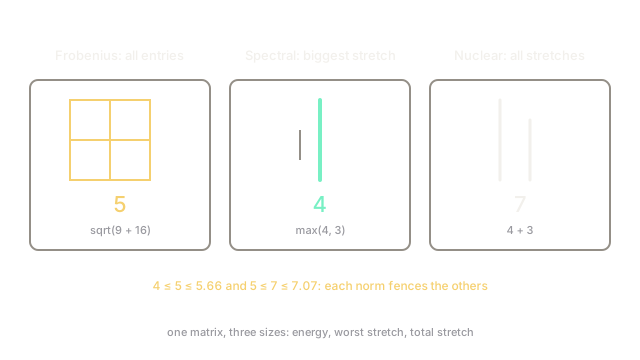
Why Does This Exist?
"The weights blew up" needs a number to be actionable, and matrices offer several. The Frobenius norm adds up everything (the Euclidean length of the matrix as a long vector). The spectral norm takes the largest stretch (the top singular value). The nuclear norm adds up all the stretches (the sum of singular values). Same matrix, three sizes, three meanings.
Each runs a different application. Weight decay penalises Frobenius. Spectral normalisation in GANs and Lipschitz analysis use the spectral norm. Low-rank inducing penalties use the nuclear norm as the convex stand-in for rank. Vector norms teach the one-dimensional versions; this page lifts the idea to matrices, where the choice changes what the optimiser is allowed to be.
The one idea you need first
Singular values are the independent stretch factors of a matrix, from singular value decomposition. Two of the three norms below are functions of them; the third ignores them entirely, and that disagreement is informative.
Think of It Like This
Three ways to size up a moving company quote
A quote lists every item with its weight. How big is the move?
The Frobenius answer adds up all the weights in quadrature: total stuff, one number. The spectral answer names the single heaviest item: the piano that decides whether the doorframe suffices. The nuclear answer adds every item's weight linearly: the total the truck must carry.
Same inventory, three numbers for three decisions: overall scale, worst bottleneck, total capacity. Matrix norms divide ML questions the same way: regularisation strength, worst-case amplification, rank budget.
How It Actually Works
For with singular values :
- Frobenius: . Entrywise energy. Cheap: one pass, no decomposition.
- Spectral: . Worst-case stretch: . The Lipschitz constant of the linear map.
- Nuclear: . Convex envelope of rank: penalising it pushes small singular values to exactly zero, giving low rank the way L1 gives sparsity.
They fence each other: and for rank . All three are sub-multiplicative () and unitarily invariant.
Worked example
Take the diagonal , whose singular values are and (signs wash out):
- Frobenius:
- Spectral:
- Nuclear:
One matrix, sizes 5, 4, 7. The inequalities check: and . If this matrix were a layer, spectral normalisation would divide it by 4 to cap its Lipschitz constant at 1.
Code
The point is the check: compute all three and verify the fencing inequalities hold.
import numpy as np
A = np.array([[3.0, 0.0], [0.0, -4.0]])fro = float(np.linalg.norm(A, "fro"))spec = float(np.linalg.norm(A, 2))nuc = float(np.linalg.norm(A, "nuc"))print([fro, spec, nuc]) # -> [5.0, 4.0, 7.0]print(spec <= fro <= (2**0.5) * spec) # -> TrueWatch Out For
Regularising Frobenius while reasoning about worst cases
Weight decay caps total energy (Frobenius), but adversarial robustness and Lipschitz certificates need the worst stretch (spectral). A matrix with Frobenius norm 5 can still stretch one direction by nearly 5. Match the norm to the threat model: energy budgets get Frobenius, worst-case guarantees get spectral.
Paying for a full SVD to get the spectral norm
np.linalg.norm(A, 2) runs a complete SVD internally: for a number power iteration finds in per step. At scale, estimate the top singular value with a few power iterations instead of decomposing. Exact norms are for small matrices and certificates; estimates run production.
The Quick Version
- Frobenius adds up everything (); spectral takes the biggest stretch; nuclear adds all stretches.
- The diag(3, -4) example gives 5, 4 and 7: one matrix, three honest sizes.
- Spectral is the Lipschitz constant; nuclear is the convex stand-in for rank.
- Fencing inequalities bound each norm by the others up to factors.
- Estimate large spectral norms by power iteration instead of paying for a full SVD.