Quantifiers
Quantifiers say how many: for-all claims every member qualifies while there-exists claims at least one does, and each is refuted differently.
Why Does This Exist?
"All models degrade" and "some model degrades" demand opposite evidence, yet teams test them identically: one good result "proves" the universal, one bad result "proves" nothing about the existential. Quantifiers name the difference so testing matches the claim: universals need sweeps, existentials need one witness, and negations flip one into the other.
They underpin every guarantee and every counterexample in ML: "for all inputs the output is safe" is a universal begging for falsification, "there exists a prompt that breaks it" is an existential one red-team example proves. Propositions alone are in propositional logic; proof uses are in proof techniques.
The one idea you need first
A predicate is a claim with a blank: "x is even" is neither true nor false until is filled in. Quantifiers bind the blank across a domain: (for all ) asserts for every member, (there exists ) asserts it for at least one. Same predicate, opposite burdens.
Think of It Like This
A health inspector and a treasure hunter
A health inspector certifies "every kitchen passes": she must visit all five kitchens, and one failure sinks the certificate. A treasure hunter proves "a chest exists on this island": one unearthed chest ends the expedition, and four empty holes change nothing.
The inspector fears the single miss; the hunter needs the single hit. Negations swap their jobs: "not every kitchen passes" is proven by one failed kitchen, which is exactly a treasure hunt for a failure. The analogy stops at infinity: with endless kitchens the inspector can never finish, which is why universals over infinite domains need proofs, not visits.
How It Actually Works
For a domain and predicate :
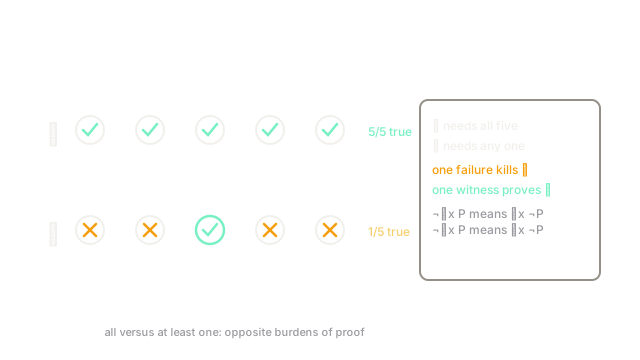
In plain words: (for all) demands true at every member with no exceptions; (there exists) demands true at one or more members, no matter how few. Refutations mirror: dies to one counterexample, dies only when every member fails. Negation flips them, the duality to memorize:
Order matters when quantifiers nest: (every gets its own ) differs from (one serves all ). "Every bug has a fix" is easy; "one fix cures every bug" is a miracle. Swapped nesting is a real source of misread guarantees.
Worked example
Five model checkpoints scored for "accuracy above 0.9": .
- : "all exceed 0.9" is FALSE: checkpoint 3 scores 0.88, one counterexample kills it.
- : "some exceed 0.9" is TRUE: checkpoint 1 at 0.93 witnesses it.
- Negation check: "not all exceed" "some do not exceed": checkpoint 3 at 0.88 witnesses that too. Duality confirmed on real numbers.
Same data, opposite verdicts, each correctly burdened. The universal needed perfection and failed; the existential needed one witness and passed.
Watch Out For
Proving a universal with cherry-picked examples
Three successful demos "prove" the model always works the way three sunny days prove eternal sunshine. Universals over large or infinite input spaces cannot be established by examples at all: each new input is another unvisited kitchen.
Test universals adversarially, hunting the counterexample, and promote them to proven only via argument, never via demo count. If examples are all you have, downgrade the claim to "held on N tested inputs."
Swapping nested quantifiers in guarantees
"For every user there is a setting" () promises personalization; "there is a setting for every user" () promises one universal default. Shipping the first while advertising the second breaks everyone whose needs differ from the average.
Write nested claims with the quantifiers explicit and check which variable depends on which. If one setting must serve all, that is the harder claim: prove it as such.
The Quick Version
- claims every member qualifies; claims at least one does.
- One counterexample refutes a universal; one witness proves an existential.
- Negation swaps them: not-all means some-not, and not-some means all-not.
- Scores kill "all above 0.9" and prove "some above."
- Nesting order changes meaning: differs from .
- Test universals by hunting counterexamples, never by counting sunny demos.