Information Extraction
Information extraction converts unstructured text into structured data formats, pulling out entities, relationships, and events.
Why Does This Exist?
The vast majority of human knowledge is recorded in unstructured text—news articles, medical records, financial reports, emails, and academic papers. While this format is perfectly suited for human reading, it is virtually useless for traditional database queries, automated reasoning, or large-scale analytics. You cannot run a standard SQL query on a folder of PDFs to find all companies acquired for more than one billion dollars last year, nor can you easily filter medical transcripts for specific adverse drug reactions.
Information extraction exists to bridge this structural gap. It is the process of automatically taking unstructured text and transforming it into a structured, machine-readable format. Instead of treating a document as a mere sequence of characters or tokens, information extraction systems identify the specific entities mentioned (like companies, people, or medications), the relationships between them (who acquired whom, who works where), and the events they participate in.
As the volume of digital text grows exponentially, manual human review becomes impossible. A legal firm cannot manually read every contract to extract the liability clauses, and a financial institution cannot manually review every news wire to find executive changes. By converting prose into structured records, organizations can populate knowledge graphs, trigger automated workflows based on real-world events, and run complex analytics over millions of documents that no human team could ever read in full. It essentially turns text from a static storage medium into a dynamically queryable database.
Think of It Like This
A librarian filling out a structured form
Imagine a librarian reading a dense, multi-page biography of a historical figure. The book is full of rich narrative, anecdotes, and flowing prose. However, the librarian’s goal is not to enjoy the story, but to fill out a standardized index card with specific fields: Name, Date of Birth, Birthplace, and Major Achievements.
As the librarian reads, they scan the text, ignoring the stylistic flourishes and focusing purely on finding the facts that map to their required form. When they read "He was born in London on a rainy Tuesday in 1845," they extract "London" for Birthplace and "1845" for Date of Birth. They ignore the "rainy Tuesday" because it does not fit the schema.
Information extraction systems do exactly this, but at massive scale. The unstructured text is the biography, the structured data format is the index card, and the extraction pipeline is the librarian rapidly pulling out the facts required to populate the fields, ignoring everything else.
How It Actually Works
Information extraction is rarely a single monolithic task; rather, it is typically implemented as a pipeline of several specialized subtasks. Each stage in the pipeline takes the output of the previous stage and adds a layer of structured understanding.
1. Named Entity Recognition (NER)
The foundation of most extraction pipelines is Named Entity Recognition. Before you can determine how things are related, you must first identify what "things" are actually mentioned in the text. NER models scan the text and classify specific spans of tokens into predefined categories like PERSON, ORGANIZATION, LOCATION, DATE, or MONEY.
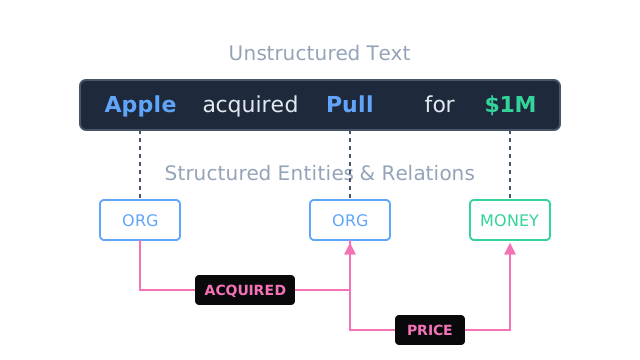
For example, given the sentence, "Apple acquired Pull string for $1M," an NER system identifies "Apple" as an ORGANIZATION, "Pull string" as an ORGANIZATION, and "$1M" as MONEY.
2. Coreference Resolution
Text frequently refers to the same entity in multiple ways. A document might mention "Apple," then "the company," and later "it." Coreference resolution is the task of clustering all these different mentions into a single underlying entity. Without this step, an extraction system might mistakenly treat "Apple" and "the company" as two separate organizations, leading to fragmented or duplicated structured data.
3. Relation Extraction
Once entities are identified and resolved, the system looks for semantic connections between them. Relation extraction classifies the relationship between a pair of entities into a predefined category. In our example, the system analyzes the span of text between the two ORGANIZATION entities ("Apple" and "Pull") and the context provided by the verb "acquired" to predict an ACQUIRED relationship. It might also extract the PRICE relationship connecting the acquisition event to the MONEY entity "$1M".
4. Event Extraction
The most complex stage is event extraction, which goes beyond binary relationships to capture multi-argument structures. An event typically has a "trigger" (the word that indicates the event happened, like "acquired") and several "arguments" that play specific roles (the acquirer, the acquired company, the price, the date). Event extraction systems must correctly identify the trigger and link all the participating entities to their correct roles within the event schema.
5. Template Filling
Beyond extracting isolated events, advanced systems perform template filling. A template is a complex, predefined schema representing a macro-event, such as a "Corporate Acquisition" or a "Terrorist Attack". The system must scan the entire document, gather facts scattered across multiple sentences or paragraphs, and synthesize them to fill out the slots in the template. This requires deep contextual understanding and often relies on coreference resolution to link facts stated in different parts of the text back to the central event.
Modern approaches often use large language models and prompt engineering to perform all these steps jointly, asking the model to directly output a JSON structure matching the desired schema in a single pass. However, dedicated pipelines of smaller, specialized models (often transformer-based, like BERT) remain heavily used in production for their speed, predictability, and lower inference cost.
Code
This snippet demonstrates a simple information extraction pipeline using a pre-trained Transformer model from the transformers library, performing Named Entity Recognition to pull out structured entities from text.
from transformers import pipeline
# Load a pre-trained Named Entity Recognition pipeline# This model classifies tokens into categories like ORG, PER, LOC, MISCner_pipeline = pipeline( "ner", model="dbmdz/bert-large-cased-finetuned-conll03-english", aggregation_strategy="simple")
text = "Apple acquired Pull for $1M in San Francisco."
# Run the pipelineextracted_entities = ner_pipeline(text)
# The output is a list of dictionaries, which is already a structured formatprint("Structured Entities:")for entity in extracted_entities: # -> Entity: Apple, Type: ORG, Confidence: 0.99 # -> Entity: Pull, Type: ORG, Confidence: 0.98 # -> Entity: San Francisco, Type: LOC, Confidence: 0.99 print(f"Entity: {entity['word']}, Type: {entity['entity_group']}, Confidence: {entity['score']:.2f}")
# A downstream system would now take these typed entities and feed them # into a relation extraction model to find the connections between them.The aggregation_strategy="simple" argument tells the pipeline to automatically merge adjacent tokens that belong to the same entity (e.g., merging "San" and "Francisco" into a single LOC entity), which is a crucial practical step in going from token-level predictions to usable structured data.
Watch Out For
Assuming extraction is a solved problem with large language models
While large language models are remarkably good at zero-shot information extraction (simply asking for JSON in the prompt), they are not infallible. They can hallucinate entities that were not in the source text, subtly alter the phrasing of extracted spans, or struggle with complex, highly technical domains where the relationships are nuanced.
Furthermore, using a massive LLM to extract names and dates from millions of routine documents is often prohibitively expensive and slow compared to a fine-tuned, specialized extraction model. Do not default to the largest available model without evaluating the cost and latency requirements of your production pipeline.
Building brittle downstream systems
Information extraction models are statistical, meaning they will make mistakes. An entity will be misclassified, or a relation will be extracted backwards. If the database or workflow that consumes the extracted structured data expects perfect accuracy and crashes when given a malformed record, the entire system will fail.
Always build downstream systems to be robust to extraction errors. Include confidence thresholds, allow for human-in-the-loop validation for high-stakes extractions, and design schemas that can handle missing or uncertain fields gracefully without bringing down the wider application.
The Quick Version
- Information extraction transforms unstructured text into structured, machine-readable formats like tables or knowledge graphs.
- It unlocks the ability to query, analyze, and automate workflows based on the raw contents of documents at scale.
- The process typically involves a pipeline of subtasks: identifying entities (NER), resolving pronouns (Coreference), and finding connections (Relation Extraction).
- Modern pipelines can use either highly specialized, smaller models for each step or large language models prompted to output structured formats directly.
- Accuracy is never perfect; downstream systems must be carefully designed to handle probabilistic outputs and occasional extraction errors.