Relation Extraction
Relation extraction identifies semantic relationships between entities in text, such as determining that a person is employed by an organization.
Why Does This Exist?
Natural language text contains an enormous amount of factual information, but that information is unstructured. Named Entity Recognition (NER) is a crucial first step, picking out the key nouns like people, organizations, locations, and dates. However, just knowing that "Tim Cook" is a person and "Apple" is an organization does not tell a machine what the relationship is between them. Without connecting these entities, downstream systems cannot answer complex questions or build meaningful representations of the world.
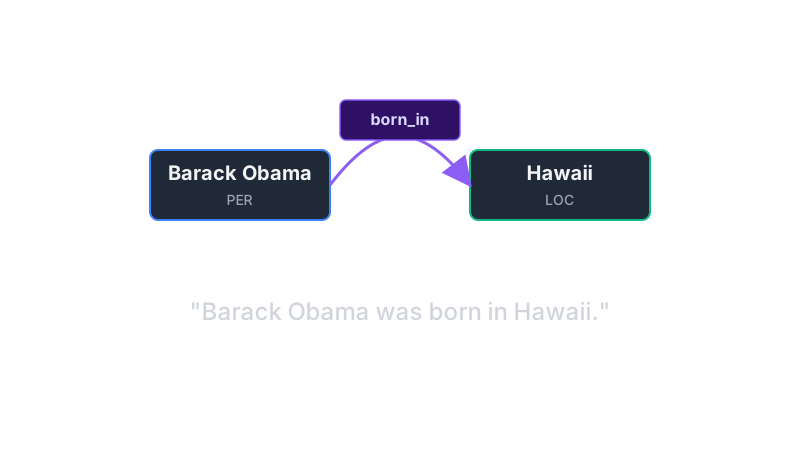
Relation extraction bridges this gap. It takes a text with identified entities and determines the semantic relationships between them. For instance, given the sentence "Tim Cook is the CEO of Apple," a relation extraction system will identify that a works_for or is_ceo_of relationship exists between "Tim Cook" (PER) and "Apple" (ORG).
This extraction of (subject, relation, object) triplets is the foundation for building Knowledge Graphs. These graphs power modern search engines, enabling them to return direct answers (like "Who is the CEO of Apple?") instead of just a list of links. It is also essential for biomedical text mining (discovering which drugs treat which diseases from millions of medical papers), intelligence analysis, and automated financial research.
Think of It Like This
Connecting the dots on a detective's corkboard
Imagine a detective investigating a complex case. They have a corkboard covered in photographs of suspects, locations, and vehicles. These photos represent the entities (found via Named Entity Recognition).
However, a board full of isolated photos isn't a theory of the crime. The detective must connect the photos with pieces of red string and attach little notes to the strings: "seen at," "owns," or "called."
Relation extraction is the process of drawing those strings and writing those notes automatically. It turns a disjointed list of people and places into a connected web of facts, explaining exactly how everything fits together.
How It Actually Works
At its core, relation extraction is typically framed as a classification problem. Given a sentence and two identified entities within it, the goal is to classify the relationship between them into one of a predefined set of relation types (or a "no relation" class).
1. Identifying Entities (The Prerequisite)
Before relation extraction can occur, the system must know where the entities are. This is usually handled by a standard NER model. For the sentence: "In 1998, Larry Page and Sergey Brin founded Google in California." The NER model tags:
- Larry Page (PER)
- Sergey Brin (PER)
- Google (ORG)
- California (LOC)
2. Generating Candidate Pairs
The system then pairs up the entities to evaluate potential relationships. Not all pairs will have a relationship. In the example above, potential pairs include:
- (Larry Page, Google)
- (Sergey Brin, Google)
- (Google, California)
- (Larry Page, California)
The model evaluates each pair in the context of the sentence to determine if a semantic relationship exists.
3. Relation Classification Architectures
Historically, relation extraction relied on rule-based patterns (e.g., if you see "X is the CEO of Y", extract works_for(X, Y)). While highly precise, these methods were brittle.
Modern architectures utilize deep learning:
- Contextual Encoders (Transformers): Models like BERT or RoBERTa read the entire sentence. To help the model focus on the specific entities being evaluated, special marker tokens are inserted around the entities. For example: "In 1998, [E1] Larry Page [/E1] and Sergey Brin founded [E2] Google [/E2] in California."
- Encoding and Classification: The transformer produces a contextualized representation of the sentence. Often, the representations corresponding to the
[E1]and[E2]markers are concatenated and passed through a fully connected classification layer. - Output: The final layer outputs a probability distribution over the possible relation types, such as
founder_of,works_for,located_in, orNone.
4. Joint Entity and Relation Extraction
A major evolution in recent years is the shift toward joint models. Instead of running NER and then passing the outputs to a separate relation classifier (a pipeline approach), joint models predict entities and relations simultaneously. This prevents cascading errors—where a mistake in the NER step permanently dooms the relation extraction step—and allows the model to use the relation context to better guess the entity types, and vice versa.
Code
This example uses the popular transformers library to run a pipeline that performs zero-shot relation extraction, using a model trained on the REBEL (Relation Extraction By End-to-end Language generation) dataset.
from transformers import pipeline
# Load a pre-trained relation extraction model# REBEL frames relation extraction as a sequence-to-sequence translation taskextractor = pipeline("text2text-generation", model="Babelscape/rebel-large")
text = "Satya Nadella is the CEO of Microsoft, which is headquartered in Redmond."
# Generate the triplet outputoutput = extractor(text, max_new_tokens=256)
# The model outputs a structured string (with special tokens).# We would typically parse this string into actual Python dictionaries.# A simplified conceptual parsing of the output would yield:# -> {'head': 'Satya Nadella', 'type': 'CEO', 'tail': 'Microsoft'}# -> {'head': 'Microsoft', 'type': 'headquarters location', 'tail': 'Redmond'}
print(output[0]['generated_text'])For production environments, teams often fine-tune large language models (LLMs) via prompt engineering or instruction tuning to extract structured JSON containing these triplets directly from text.
Watch Out For
Cascading errors in pipeline architectures
If you use a two-step pipeline (NER followed by relation classification), any entity missed by the NER model cannot have a relation extracted, no matter how good the relation classifier is. Furthermore, if NER misclassifies an entity (e.g., tagging a company as a person), the relation classifier might confidently predict an absurd relationship. Consider using joint extraction models if error propagation becomes a bottleneck.
Long-distance and cross-sentence relations
Standard relation extraction models operate on a single sentence at a time. However, in real-world documents, an entity might be introduced in paragraph one, and its relationship to another entity might be established in paragraph three. Resolving this requires coreference resolution (figuring out that "the company" in paragraph three refers to "Microsoft" in paragraph one) and document-level relation extraction, which is significantly harder and more computationally expensive than sentence-level extraction.
The Quick Version
- Relation extraction identifies and classifies semantic relationships between entities in text, turning unstructured sentences into structured (subject, relation, object) facts.
- These extracted facts are essential for building knowledge graphs, answering complex queries, and performing large-scale text mining.
- Modern systems use transformer models (like BERT) to classify relationships by reading the sentence context surrounding pairs of entities.
- Pipeline approaches do NER first and relation extraction second, while joint models predict both simultaneously to avoid cascading errors.
- Extracting relationships across multiple sentences remains a complex challenge, often requiring coreference resolution to link pronouns and aliases back to the main entities.