Paper breakdown
Parameter-Efficient Transfer Learning for NLP
Introduces adapter modules, a parameter-efficient alternative to full fine-tuning that adds only a few trainable parameters per task while keeping the pre-trained model weights frozen.
Paper: Parameter-Efficient Transfer Learning for NLP
Authors: Neil Houlsby, Andrei Giurgiu, Stanislaw Jastrzebski, Bruna Morrone, Quentin de Laroussilhe, Andrea Gesmundo, Mona Attariyan, Sylvain Gelly · 2019
Read the paper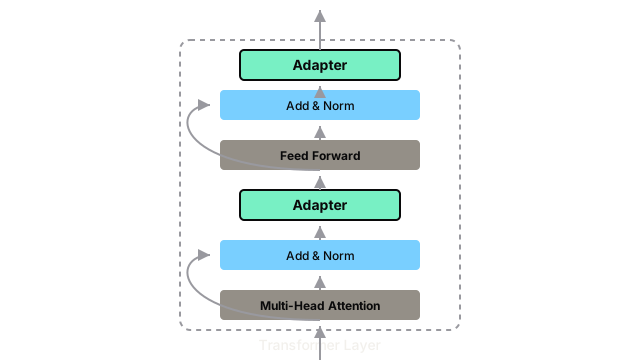
The Problem
The standard approach for leveraging large pre-trained language models (like BERT) for specific tasks is full fine-tuning, where all the model's parameters are updated. As models grow larger and the number of downstream tasks increases, fine-tuning becomes highly inefficient. Storing a complete copy of a massive model for every single task is storage-intensive and computationally expensive. We need a way to adapt large models to new tasks without duplicating their entire parameter set.
The Idea
Instead of updating all the weights of a pre-trained model, the authors propose inserting small, trainable "adapter modules" between the layers of the frozen pre-trained model. During training on a new task, only the weights of these new adapter modules (and the layer normalization parameters) are updated, while the massive original weights of the model remain completely fixed.
How It Works
The adapter architecture is designed to be highly parameter-efficient:
- Bottleneck Architecture: Each adapter module uses a bottleneck design. It first projects the original -dimensional features down to a smaller dimension (where ), applies a non-linearity, and then projects the features back up to dimensions. This severely restricts the number of parameters added.
- Skip Connection: A skip connection bypasses the adapter bottleneck. If the adapter weights are initialized to near zero, the module approximates an identity function at the start of training, ensuring that the original pre-trained representations are uncorrupted initially.
- Placement: In a standard Transformer, adapter modules are inserted twice per layer: once after the multi-head attention sub-layer and once after the feed-forward sub-layer.
- Training: The pre-trained model weights are frozen. Only the adapter weights (a fraction of the total model size) are trained on the downstream task.
Why It Mattered
The Adapters paper was a foundational work in what would become known as Parameter-Efficient Fine-Tuning (PEFT). The authors showed that by training only ~3.6% of the parameters of a BERT model, they could achieve performance on the GLUE benchmark within 0.4% of full fine-tuning. This dramatically reduced the storage footprint for multi-task deployments, allowing a single large model to serve dozens of specific tasks just by swapping in tiny, task-specific adapter weights.
What Came After
Adapters sparked a massive wave of research into PEFT methods. While the original adapter modules are still used, the field expanded rapidly to include other highly successful techniques like Prefix-Tuning, Prompt Tuning, and notably, Low-Rank Adaptation (LoRA). Today, adapter-like techniques are standard practice for fine-tuning massive Large Language Models (LLMs) on consumer hardware, enabling the open-source community to adapt models that would otherwise be too large to train.