Prefix-Tuning: Optimizing Continuous Prompts for Generation
Proposes a lightweight alternative to fine-tuning for natural language generation tasks, which keeps language model parameters frozen, but optimizes a small continuous task-specific vector (prefix).
Paper: Prefix-Tuning: Optimizing Continuous Prompts for Generation
Authors: Xiang Lisa Li, Percy Liang · 2021
Read the paper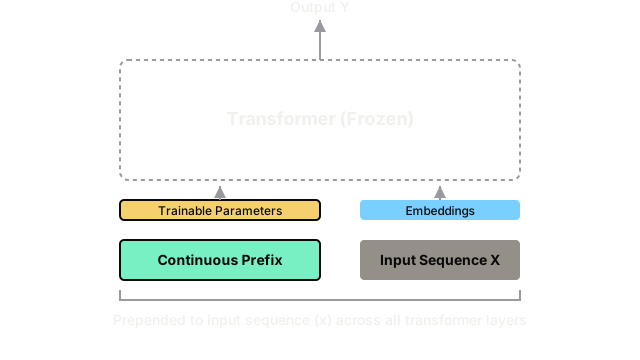
The Problem
Fine-tuning large language models (LLMs) for specific natural language generation tasks (like summarization or data-to-text) requires modifying and storing all model parameters for every task. While techniques like Adapters introduced parameter-efficient tuning by adding small neural modules within the network, they still alter the model's internal architecture. Conversely, standard text prompting is lightweight but often brittle, restricted by context length, and performs worse than full fine-tuning.
The Idea
Inspired by text prompting, Prefix-Tuning proposes prepending a sequence of trainable, continuous "virtual tokens" (a prefix) to the input. Instead of searching for discrete word tokens that make up a good prompt, Prefix-Tuning optimizes these continuous vectors directly via gradient descent. The entire pre-trained language model remains completely frozen; only the small continuous prefix is trained to steer the model towards the desired task.
How It Works
Prefix-Tuning operates by manipulating the keys and values within the Transformer's attention mechanism:
- Continuous Prefix: A prefix of length is prepended to the input sequence. Unlike text tokens, this prefix consists of free, continuous parameters.
- Modifying Attention: In every layer of the Transformer (not just the input layer), these continuous prefix vectors are concatenated to the standard key and value matrices. When the model processes the actual input text, it attends to this learned prefix as if it were a sequence of real tokens that appeared earlier in the context.
- Reparameterization: Directly optimizing the prefix parameters can lead to instability. The authors solve this by reparameterizing the prefix using a smaller multi-layer perceptron (MLP). Once training is complete, the MLP is discarded, and only the final generated prefix vectors are stored.
- Freezing the LLM: During training, all weights of the original LLM are frozen. The gradients only update the prefix parameters (representing just 0.1% of the model's total size).
Why It Mattered
Prefix-Tuning proved that you could achieve performance comparable to full fine-tuning on complex generation tasks while training only a tiny fraction of the parameters (0.1% vs full 100%). It offered a more modular approach than Adapters, as it didn't require modifying the model's internal layers, just the inputs to the attention mechanism. Furthermore, Prefix-Tuning showed strong robustness out-of-distribution, suggesting that by keeping the base model frozen, it better preserved the model's generalized knowledge.
What Came After
Prefix-Tuning significantly advanced the field of Prompt Tuning and Parameter-Efficient Fine-Tuning (PEFT). It led to subsequent innovations like Prompt Tuning (which simplifies the approach by only optimizing prompts at the input layer rather than all layers) and heavily influenced the development of techniques used to control large language models efficiently. Today, prefix-based and prompt-based tuning methods are integral for deploying multi-task LLM systems efficiently.