Paper breakdown
Attention Is All You Need
The landmark 2017 paper that introduced the Transformer architecture, replacing RNNs with self-attention and launching the modern era of large language models.
Paper: Attention Is All You Need
Authors: Ashish Vaswani, Noam Shazeer, Niki Parmar, Jakob Uszkoreit, Llion Jones, Aidan N. Gomez, Lukasz Kaiser, Illia Polosukhin · 2017
Read the paper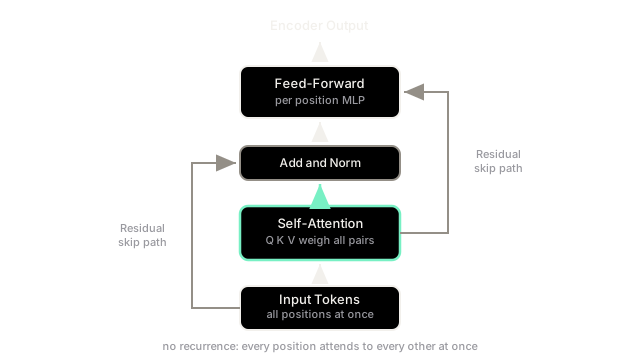
The Problem
Before 2017, the state of the art in sequence-to-sequence tasks like machine translation relied on Recurrent Neural Networks (RNNs) and Long Short-Term Memory networks (LSTMs). These architectures processed sequences step-by-step: to understand the tenth word in a sentence, the network had to process the first nine words sequentially, accumulating their meaning into a hidden state.
This created two massive problems. First, it choked on long sequences. The hidden state became a bottleneck, struggling to remember the start of a paragraph by the time it reached the end. Second, sequential processing meant training could not be parallelized across GPUs. You could not compute step ten until step nine was finished. The industry was hitting a hard ceiling on training efficiency and model scale.
The Idea
The Google Brain and Google Research team proposed a radical alternative: throw away recurrence entirely and rely solely on an "attention" mechanism to align inputs and outputs.
Attention wasn't new; it had been used alongside RNNs to help them "look back" at specific parts of the input sequence. The breakthrough in Attention Is All You Need was the realization that attention was powerful enough to carry the entire architecture. By using a mechanism called Self-Attention, the model could look at the entire sequence at once and calculate how strongly each word related to every other word, regardless of their distance from each other.
How It Works
The Transformer uses an encoder-decoder structure, but built out of entirely new blocks.
Self-Attention. Instead of passing a hidden state sequentially, the network projects every input token into three vectors: a Query (what the token is looking for), a Key (what the token contains), and a Value (what the token contributes). To process a word, the network takes its Query and takes the dot product with the Keys of every other word in the sequence. A high score means the words are strongly related. These scores become weights used to sum the Values. This happens for every word simultaneously.
Multi-Head Attention. Instead of computing self-attention once, the Transformer does it multiple times in parallel ("heads") with different learned projections. This allows the model to attend to different types of relationships simultaneously—one head might track grammatical structure, while another tracks pronoun references.
Positional Encoding. Because there is no sequential processing, the model natively has no idea which word came first. To fix this, the authors added fixed mathematical signals (sine and cosine waves of different frequencies) to the input embeddings to inject positional information, giving the model a sense of sequence order.
Why It Mattered
Attention Is All You Need removed the sequential bottleneck of deep learning. Because self-attention processes the entire sequence in parallel matrix multiplications, it unlocked massive training parallelization. GPUs could suddenly be utilized to their full potential.
This single shift made it possible to train models on datasets orders of magnitude larger than before. It proved that attention mechanisms were not just a supporting trick for RNNs, but a superior foundational architecture for sequence modeling.
What Came After
This paper is arguably the most consequential publication in the history of deep learning. It triggered a total architectural convergence.
Within a year, OpenAI introduced GPT (Generative Pre-trained Transformer) and Google introduced BERT (Bidirectional Encoder Representations from Transformers). Both stripped away either the encoder or decoder half of the original architecture and scaled it up massively. Today, the Transformer is the undisputed foundation of all modern Large Language Models (LLMs), vision transformers, and multimodal AI. The entire generative AI era is built on the architecture introduced in this paper.