Rethinking Positional Encoding (RoPE)
An exploration of Rotary Position Embedding (RoPE), detailing how it mathematically unifies absolute and relative positional encoding for Transformers.
Paper: RoFormer: Enhanced Transformer with Rotary Position Embedding
Authors: Jianlin Su, Yu Lu, Shengfeng Pan, Ahmed Murtadha, Bo Wen, Yunfeng Liu · 2021
Read the paper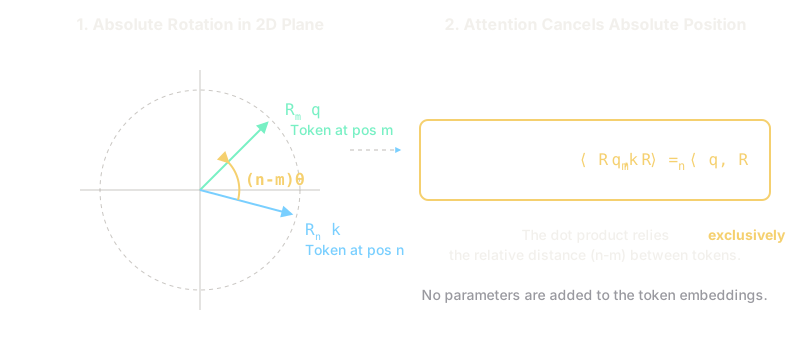
The Problem
Standard Transformers inherently lack an understanding of sequence order, treating inputs as a "bag of words." The original approach to this limitation was to add absolute sine and cosine positional encodings to token embeddings before the first layer.
However, language heavily relies on the relative distance between words rather than their absolute positions. Existing relative positional encodings often involved modifying the attention matrix directly, which introduced computational complexity and slowed down operations. There was a pressing need for a mechanism that could capture relative distances seamlessly and efficiently without creating new architectural bottlenecks.
The Idea
The core insight behind Rotary Position Embedding (RoPE) was to mathematically encode absolute positions in such a way that the attention calculation (the dot product of the Query and Key vectors) would exclusively depend on the relative distance between tokens.
Instead of simply adding a positional vector to the embeddings, RoPE treats the Query and Key vectors as complex numbers and rotates them in a 2D plane. The rotation angle is directly proportional to the absolute position of each token in the sequence.
How It Works
Pairing Dimensions The standard embedding vector is split into consecutive pairs of 2D coordinates.
Applying Rotations For a token located at position , each 2D pair is rotated by an angle , where is a pre-defined frequency specific to that pair.
Layer-wise Integration Unlike absolute embeddings added only at the input, this rotation is applied directly to the Query and Key vectors right before they are multiplied in the attention mechanism across every layer.
Value Vectors Untouched The Value vectors do not undergo any rotation.
Because of the mathematical properties of rotation matrices and complex dot products, when a rotated Query is multiplied by a rotated Key, the absolute angles mathematically cancel out. The resulting dot product inherently reflects the angle difference, effectively encoding the relative distance directly into the attention scores.
Why It Mattered
RoPE introduced an elegant and computationally inexpensive solution to positional encoding. It allowed models to retain absolute positional awareness while natively reacting to relative distances within the attention mechanism. Furthermore, it demonstrated significant potential for length extrapolation, enabling models trained on shorter sequences to maintain performance when deployed on much longer text contexts.
What Came After
RoPE rapidly superseded older methods and became the industry standard for positional encoding in modern architectures. It was adopted by major models including LLaMA, PaLM, Mistral, and DeepSeek, cementing its status as one of the most impactful architectural improvements since the original Transformer.