BigGAN
Scaled up Generative Adversarial Networks to create high-resolution, high-fidelity images using large batch sizes and the truncation trick.
Paper: Large Scale GAN Training for High Fidelity Natural Image Synthesis
Authors: Andrew Brock, Jeff Donahue, Karen Simonyan · 2018
Read the paper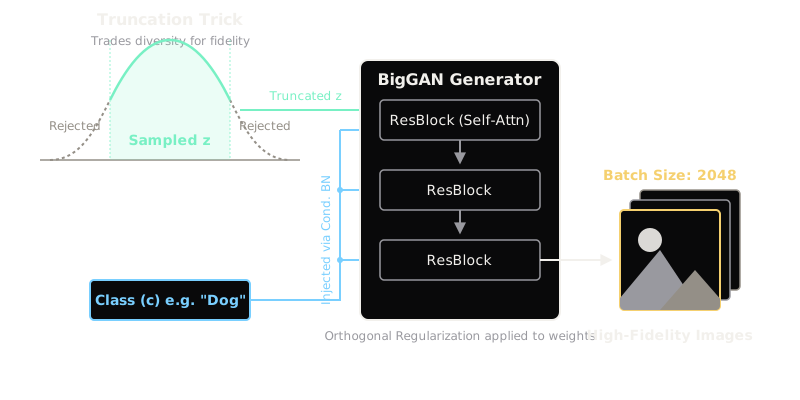
The Problem
While Generative Adversarial Networks (GANs) could produce compelling images, generating high-resolution, high-fidelity images with high variation (like the 1000 classes of ImageNet) was notoriously unstable. Previous architectures struggled with mode collapse and required careful hyperparameter tuning, hitting a ceiling in terms of visual quality and diversity on complex datasets.
The Idea
The authors discovered that GANs benefit massively from scale. By simply training on much larger batches and adding more parameters, performance improves significantly. To control the trade-off between image diversity and image fidelity during sampling, they introduced the truncation trick, alongside architectural tweaks like self-attention and orthogonal regularization to stabilize the massive scale.
How It Works
Massive Batch Sizes BigGAN scaled the batch size from standard sizes (like 256) up to 2048. A larger batch covers more modes of the data distribution in a single step, providing better gradients for both the generator and discriminator.
The Truncation Trick During training, the generator takes random noise drawn from a standard normal distribution. During inference, if values that fall outside a certain range are resampled to fall within a truncated normal distribution, the generator produces much higher fidelity (more realistic) images, at the cost of overall diversity.
Class-Conditional Generation To guide the generation process toward specific classes, the class embedding is injected into the generator through Conditional Batch Normalization layers, allowing the network to modulate feature maps based on the target class.
Orthogonal Regularization and Self-Attention To prevent the model from becoming unstable at these scales, they applied orthogonal regularization to the generator's weights. They also integrated the self-attention mechanism to capture long-range dependencies in the images.
Why It Mattered
BigGAN proved that scaling up standard GAN architectures—without necessarily inventing radically new adversarial losses—results in a dramatic leap forward. It became the state-of-the-art for ImageNet generation, demonstrating that GANs could handle highly complex and diverse datasets at high resolution (up to 512x512) with breathtaking realism.
What Came After
BigGAN set the standard for class-conditional image generation until diffusion models overtook GANs. Its focus on scale and engineering stability influenced the development of subsequent models like VQ-GAN and informed the broader trend of massive scaling in deep learning. StyleGAN, developed around the same time, tackled the unconditioned, high-resolution generation problem using a different approach to latent spaces.