Paper breakdown
A Style-Based Generator Architecture for GANs
StyleGAN revolutionized image generation by disentangling latent spaces and enabling fine-grained control over generated features at different scales.
Paper: A Style-Based Generator Architecture for GANs
Authors: Tero Karras, Samuli Laine, Timo Aila · 2019
Read the paper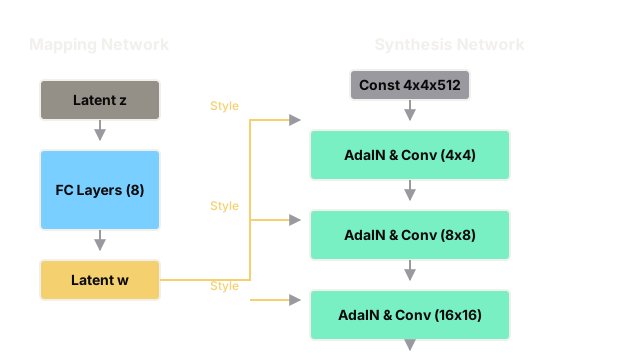
The Problem
Traditional Generative Adversarial Networks (GANs) mapped a latent vector directly to an image through a series of transposed convolutions, treating the latent space as a tangled black box. This made it virtually impossible to control specific features of the generated image—changing the latent vector to alter hair color often inadvertently changed facial structure, pose, or lighting. The lack of a disentangled latent space prevented fine-grained, localized control over the generation process.
The Idea
Rather than feeding the input latent code strictly through the input layer of the generator network, the researchers proposed a style-based generator architecture. They decoupled the latent space by using a mapping network to transform the initial latent vector into an intermediate latent space. This intermediate vector is then fed into the synthesis network at multiple layers, treating it as a "style" that controls the features of the image at different resolutions.
How It Works
The StyleGAN architecture rethinks the generator primarily through three mechanisms:
The Mapping Network: An 8-layer multi-layer perceptron (MLP) transforms the original latent vector into an intermediate latent space (). This mapping network unwarps the space, reducing entanglement so that individual dimensions correspond more cleanly to specific visual features.
Style Injection via AdaIN: Instead of feeding the latent vector into the first layer, the generator starts with a learned constant tensor. The intermediate latent vector is mapped to "styles" (scaling and shifting factors) that are injected after every convolutional layer using Adaptive Instance Normalization (AdaIN). Styles injected at lower resolutions affect coarse features (pose, face shape), while those at higher resolutions dictate fine details (hair color, texture).
Noise Inputs: To generate stochastic details like hair placement, freckles, or skin pores—features that don't need to be globally coordinated—StyleGAN injects explicit, scaled Gaussian noise directly into the feature maps at every resolution. This frees the generator's capacity from trying to fake randomness.
Why It Mattered
StyleGAN broke the barrier of uncontrolled generation. For the first time, developers and artists could explicitly mix styles from different images (borrowing the pose from one latent code and the lighting from another) by simply swapping the style vectors at specific layers. It also dramatically improved the photorealism of generated images, leading to the viral "This Person Does Not Exist" website.
What Came After
StyleGAN laid the foundation for an entire lineage of high-fidelity generators. NVIDIA subsequently released StyleGAN2 to fix artifacting issues, and StyleGAN3 to achieve true translation and rotation equivariance. It also spawned a massive subfield of "GAN inversion," where researchers developed methods to map real images back into the space to realistically edit real photographs using StyleGAN's disentangled controls.