BLIP-2: Bootstrapping Language-Image Pre-training
Proposes a compute-efficient pre-training strategy for vision-language models that bootstraps from off-the-shelf frozen image encoders and frozen large language models using a lightweight Querying Transformer.
Paper: BLIP-2: Bootstrapping Language-Image Pre-training with Frozen Image Encoders and Large Language Models
Authors: Junnan Li, Dongxu Li, Silvio Savarese, Steven Hoi · 2023
Read the paper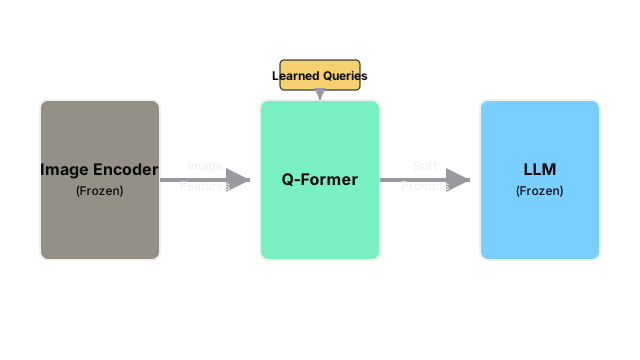
The Problem
Training large vision-language models end-to-end is incredibly expensive in terms of computational resources and data requirements. While massive unimodal models (like image-only ViTs or text-only LLMs) have shown remarkable capabilities, bridging them to create multimodal models typically requires training billions of parameters from scratch or extensively fine-tuning them on paired image-text datasets, leading to high costs and potential catastrophic forgetting of their unimodal abilities.
The Idea
BLIP-2 proposes a "bootstrapping" approach: instead of training the massive image and text models, keep them completely frozen. To bridge the modality gap, BLIP-2 introduces a lightweight, trainable component called the Querying Transformer (Q-Former). The Q-Former acts as an informational bottleneck and translator, extracting only the most relevant visual features from the frozen image encoder and feeding them into the frozen LLM in a format the LLM can understand, achieving state-of-the-art multimodal performance with a fraction of the trainable parameters.
How It Works
BLIP-2's architecture relies on the Q-Former, trained in a two-stage process:
- The Q-Former: A lightweight transformer that uses a set of learnable query vectors. These queries interact with the frozen image encoder's output via cross-attention, extracting a fixed number of visual features regardless of the input image resolution.
- Stage 1 - Vision-Language Representation Learning: The Q-Former is connected to a frozen image encoder. It is trained on image-text pairs using three objectives: Image-Text Contrastive learning (matching images to text), Image-grounded Text Generation (generating text from image features), and Image-Text Matching (predicting if an image and text pair).
- Stage 2 - Vision-to-Language Generative Learning: The trained Q-Former is then connected to a frozen LLM (e.g., OPT or Flan-T5). The output of the Q-Former is projected into the same dimension as the LLM's text embeddings. The LLM processes these projected visual queries as a "soft prompt," allowing it to generate text based on the visual input.
Why It Mattered
BLIP-2 demonstrated that you do not need to train massive models end-to-end to achieve state-of-the-art vision-language capabilities. By freezing the heavy lifting components (the image encoder and LLM), BLIP-2 slashed training costs and time while outperforming models with significantly more trainable parameters (like Flamingo). It proved that the knowledge already embedded in powerful unimodal models could be efficiently harvested and aligned using a small, smart intermediary layer.
What Came After
BLIP-2 set a new standard for efficient multimodal model training. It heavily influenced the development of open-source Vision-Language Models (VLMs) like InstructBLIP, MiniGPT-4, and LLaVA, which further extended this paradigm by incorporating instruction tuning. The strategy of using a bridging module (like the Q-Former or simpler projection layers) between frozen vision encoders and frozen LLMs has become the dominant approach for building modern multimodal AI systems.