Unpaired Image-to-Image Translation using Cycle-Consistent Adversarial Networks
Introduced cycle consistency loss to enable image-to-image translation without needing paired examples in the training dataset.
Paper: Unpaired Image-to-Image Translation using Cycle-Consistent Adversarial Networks
Authors: Jun-Yan Zhu, Taesung Park, Phillip Isola, Alexei A. Efros · 2017
Read the paper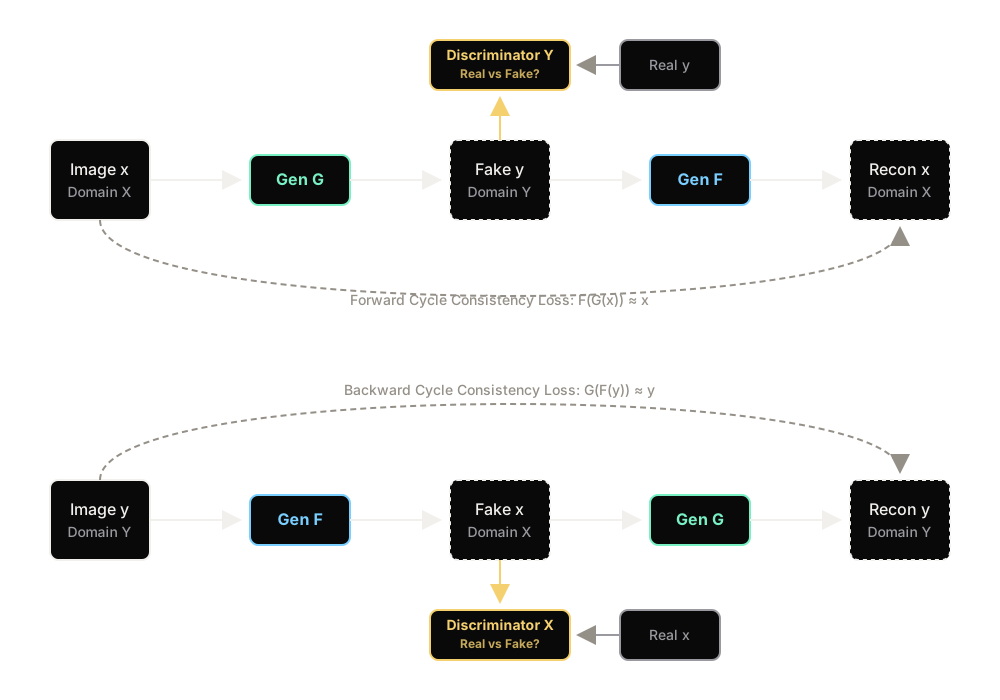
The Problem
Before this paper, image-to-image translation tasks (like turning a sketch into a photo, or a daytime scene into night) relied heavily on paired training data. Models like pix2pix required a dataset where each input image had an exact, pixel-perfect corresponding output image. However, for many tasks—such as translating paintings by Monet into realistic photos, or turning horses into zebras—obtaining exactly paired images is literally impossible. The field lacked a reliable way to map between two visual domains using only unstructured, unpaired collections of images.
The Idea
The authors realized that if you have a mapping from domain X to domain Y, you should be able to map back from Y to X and arrive at the exact same starting point. By training two generators simultaneously and forcing them to form a closed loop—a constraint they called cycle consistency—the network could learn meaningful mappings without ever seeing a paired example. If a generator turned a specific horse into a zebra, the second generator had to turn that exact zebra back into the original horse.
How It Works
The CycleGAN architecture relies on two distinct generator networks and two distinct discriminator networks operating in tandem.
Two Generators and Discriminators Generator learns to translate images from domain X (e.g., horses) to domain Y (e.g., zebras). Generator learns the reverse mapping, from Y to X. Each domain has its own discriminator ( and ) which tries to distinguish real images in that domain from the generated ones.
Adversarial Loss Just like a standard GAN, the generators try to fool their respective discriminators. Generator tries to make images that look so much like real zebras that cannot tell they are fake.
Cycle Consistency Loss Adversarial loss alone isn't enough, as could map all horses to a single, convincing zebra (mode collapse) and still fool the discriminator. To prevent this, the cycle consistency loss enforces that an image mapped to the other domain and back must reconstruct the original image: (forward cycle) and (backward cycle). This constraint strictly enforces a structured mapping between the two domains, ensuring the generated images retain the structural content of the original inputs.
Why It Mattered
CycleGAN proved that you do not need paired data to learn complex mappings between entirely different visual domains. This dramatically expanded the real-world applicability of generative models, enabling style transfer, season translation, and object transfiguration on datasets that were previously impossible to train on. It shifted the paradigm from requiring meticulously aligned datasets to simply requiring representative collections of both domains.
What Came After
CycleGAN's core concept of cycle consistency became a foundational tool in self-supervised and unsupervised learning, well beyond just image translation. It directly inspired subsequent architectures like StarGAN (for multi-domain translation), Contrastive Unpaired Translation (CUT), and numerous techniques in domain adaptation for computer vision and medical imaging where paired data is scarce.