DeepSeek-V3 Technical Report
An incredibly efficient Mixture-of-Experts architecture that pushed the limits of training cost-efficiency while matching state-of-the-art reasoning benchmarks.
The Problem
Training massive language models typically required hundreds of millions of dollars in compute, creating an insurmountable barrier for smaller labs or open-source initiatives. Furthermore, during inference, large models suffer from massive memory overhead due to the KV cache (storing the Keys and Values for every token in long contexts). As models pushed towards 100k+ token context windows, memory bottlenecks became the limiting factor for deployment.
The Idea
DeepSeek-V3 demonstrated that careful architectural innovation could drastically cut both training costs and inference memory. By combining a highly optimized Mixture-of-Experts (MoE) architecture with a novel attention mechanism called Multi-Head Latent Attention (MLA), DeepSeek-V3 matched the performance of models that cost 10x more to train, proving that extreme efficiency was the next major frontier.
How It Works
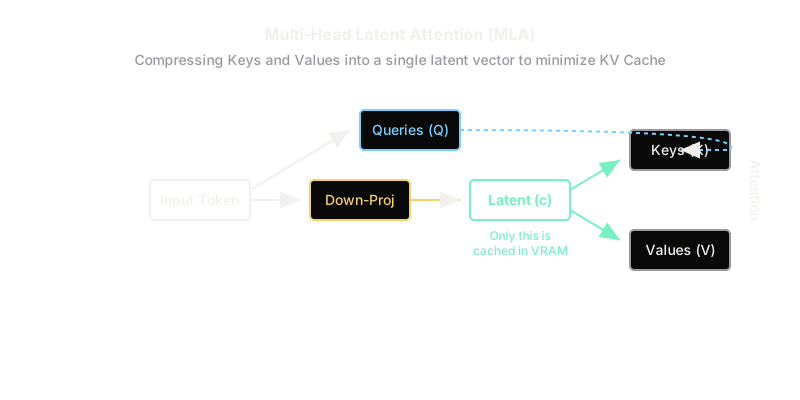
Multi-Head Latent Attention (MLA) Standard Multi-Head Attention (MHA) or Grouped-Query Attention (GQA) requires caching high-dimensional Key and Value vectors for every token during generation. MLA solves this memory explosion by compressing the Key and Value representations into a much smaller, shared "latent" vector. Instead of caching massive matrices, MLA only caches this compressed latent vector. During attention computation, it dynamically unpacks the latent vector back into Keys and Values. This reduces the KV cache memory footprint by an order of magnitude without significantly degrading reasoning quality.
Optimized Mixture-of-Experts (MoE) DeepSeek-V3 uses a sparse MoE architecture with hundreds of very small "expert" networks, but only activates a handful per token. Crucially, they implemented an auxiliary-loss-free load balancing mechanism. Traditional MoEs use an extra loss term to force the router to send tokens evenly across experts (to avoid some experts getting no data). DeepSeek's routing mechanism naturally maintained expert balance, simplifying the training objective and yielding better final performance.
FP8 Mixed Precision Training They heavily utilized FP8 (8-bit floating point) formats throughout training, pushing the boundaries of low-precision arithmetic to drastically speed up throughput on modern GPUs without causing the model to diverge.
Why It Mattered
DeepSeek-V3 was a massive shock to the AI industry. It proved that state-of-the-art frontier model capabilities (rivaling the top proprietary models in coding and math) could be achieved with a fraction of the presumed compute budget. It set a new benchmark for open-weights efficiency.
What Came After
The techniques pioneered in DeepSeek-V3 (especially MLA and their MoE routing strategies) became standard reading for any team attempting to train large open models, shifting the focus from purely scaling up parameters to scaling up architectural efficiency.