Qwen2.5: Foundation Models and Vision-Language Extensions
A suite of highly capable open-weight models achieving state-of-the-art performance across reasoning, coding, and vision tasks through extensive pre-training and alignment.
The Problem
By late 2024, the gap between open-weight models (like LLaMA 3) and proprietary models (like GPT-4o or Claude 3.5 Sonnet) was closing rapidly. However, open models still often lagged in two key areas: highly complex reasoning (especially math and coding) and robust, native multimodal capabilities (processing high-resolution images and video with precise spatial understanding). Building an open-weight ecosystem that truly rivaled the best proprietary frontier models required massive scaling in data quality and architectural refinements in vision-language integration.
The Idea
The Qwen team at Alibaba released Qwen2.5, a massive family of models ranging from 0.5B to 72B parameters. The core idea wasn't a radical new architecture, but rather an extreme optimization of the data pipeline and the training recipe. For the multimodal variant (Qwen2.5-VL), they introduced architectural improvements to handle arbitrary resolutions and video lengths dynamically, allowing the model to act as a visual agent.
How It Works
Qwen2.5 (Language Backbone) The architecture remains a standard dense Transformer (with SwiGLU, RoPE, and Grouped Query Attention). The breakthrough was in the data:
- Trained on up to 18 Trillion tokens.
- Heavy reliance on synthetic data generation (using earlier models to generate high-quality math and code data).
- Rigorous post-training alignment using DPO (Direct Preference Optimization) and RLHF, heavily heavily focused on improving instruction following and system prompt obedience.
Qwen2.5-VL (Vision-Language Integration) The VL (Vision-Language) variant introduced key improvements for visual reasoning:
- Dynamic Resolution ViT: Instead of forcing images into fixed squares (e.g., 224x224), Qwen2.5-VL uses a Vision Transformer that dynamically patches images based on their native aspect ratio and resolution.
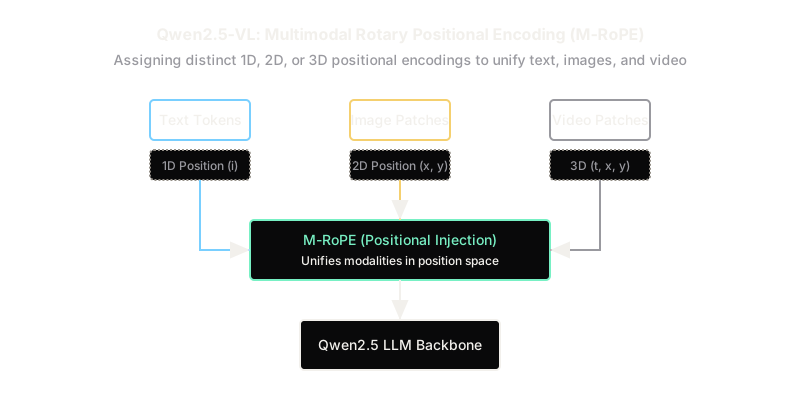
- M-RoPE (Multimodal Rotary Positional Encoding): A novel 3D positional encoding system. It assigns 1D positions to text, 2D positions to images, and 3D positions to videos. This allows the model to deeply understand spatial relationships (e.g., "what is to the left of the red car?") and temporal relationships in video.
- Visual Agent Capabilities: Due to high-resolution OCR capabilities and precise spatial localization, Qwen2.5-VL can act as a computer-use agent, directly understanding UI elements and predicting bounding boxes for interactions.
Why It Mattered
Qwen2.5 cemented itself as one of the most powerful open-weight families available, frequently topping leaderboards against LLaMA 3.1 and grok. The Qwen2.5-VL variant, in particular, set a new standard for open multimodal models, demonstrating that open weights could parse complex documents, understand UI, and reason through video at a level previously reserved for proprietary APIs.
What Came After
The release of Qwen2.5 and its variants (including Qwen2.5-Coder and Qwen2.5-Math) fueled a surge in open-source agent development, as developers finally had access to highly capable, specialized models that could run on local hardware or private servers.