Densely Connected Convolutional Networks
Introduces DenseNets, where each layer is directly connected to every other layer in a feed-forward fashion, improving feature reuse and mitigating the vanishing gradient problem.
Paper: Densely Connected Convolutional Networks
Authors: Gao Huang, Zhuang Liu, Laurens van der Maaten, Kilian Q. Weinberger · 2017
Read the paper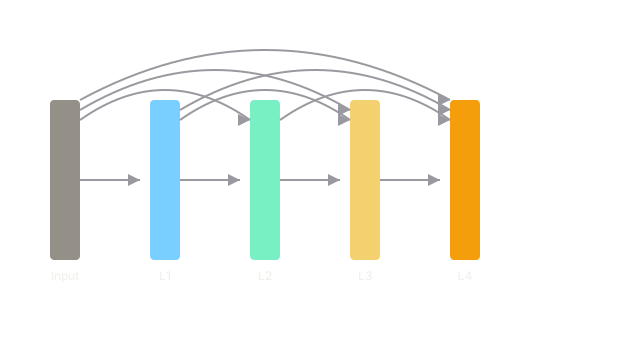
The Problem
As convolutional neural networks (CNNs) become increasingly deep, a new problem emerges: information about the input or gradient that passes through many layers can vanish and "wash out" by the time it reaches the end (or beginning) of the network. While ResNets addressed this by adding skip connections that bypass a single block of layers, they still implicitly discard information, since features are summed together, potentially impeding the flow of information throughout the network.
The Idea
Instead of drawing representations from just the previous layer or summing them (as in ResNets), what if every layer had direct access to the original input and the features learned by all preceding layers? DenseNets propose connecting each layer to every other layer in a feed-forward fashion. Within a "dense block," the feature maps of all preceding layers are treated as separate inputs to the current layer, and its own feature maps are passed on as inputs to all subsequent layers.
How It Works
DenseNets implement this extreme connectivity through a few key mechanisms:
- Dense Connectivity: In a dense block with layers, there are connections, compared to just in traditional architectures. Layer receives the concatenated feature maps from all preceding layers as input.
- Concatenation over Summation: Unlike ResNets, which combine features using element-wise addition, DenseNets combine them via concatenation. This means the network explicitly differentiates between new information and preserved older information.
- Growth Rate: Because features are concatenated, the number of channels grows. DenseNets introduce a hyperparameter called the "growth rate" (), which dictates how many new feature maps each layer produces. Even a small growth rate (e.g., ) is sufficient because the layer has access to all previously computed feature maps.
- Transition Layers: To control the spatial size of the feature maps and reduce dimensionality, dense blocks are separated by transition layers consisting of a convolution (for dimensionality reduction) and a average pooling layer.
Why It Mattered
DenseNets achieved state-of-the-art accuracy on major computer vision benchmarks (CIFAR, SVHN, ImageNet) while requiring significantly fewer parameters and less computation than competing ResNet architectures. By explicitly encouraging feature reuse, DenseNets mitigated the vanishing gradient problem naturally and yielded more compact models. They proved that networks could be both extremely deep and parameter-efficient if the flow of information was optimized.
What Came After
DenseNets became a staple architecture in computer vision, widely used for image classification, segmentation, and medical image analysis. The concept of dense connectivity influenced subsequent neural network designs, including variations for specific tasks like PeleeNet for mobile devices. While Vision Transformers (ViTs) have recently dominated large-scale vision tasks, DenseNets remain a critical milestone in the evolution of CNN architectures and are still heavily used in resource-constrained or specialized settings.