Paper breakdown
End-to-End Object Detection with Transformers
Treated object detection as a direct set prediction problem, using a Transformer encoder-decoder architecture to eliminate hand-designed anchors and non-maximum suppression.
Paper: End-to-End Object Detection with Transformers
Authors: Nicolas Carion, Francisco Massa, Gabriel Synnaeve, Nicolas Usunier, Alexander Kirillov, Sergey Zagoruyko · 2020
Read the paper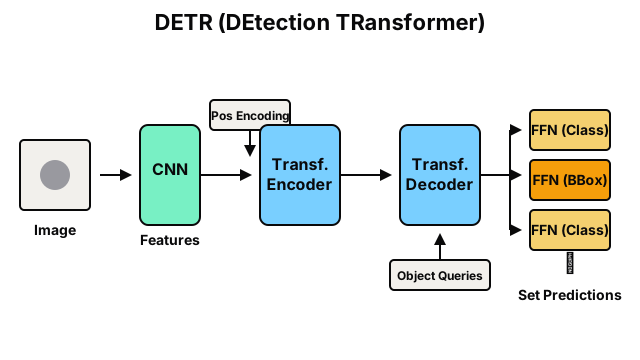
The Problem
Modern object detection architectures like Faster R-CNN and YOLO were highly performant but relied on a massive array of hand-engineered components. Specifically, they depended on predefined spatial anchors (prior boxes), complex heuristics to assign ground truth targets to those anchors, and post-processing steps like non-maximum suppression (NMS) to deduplicate predictions. These manual engineering bottlenecks made the models brittle to new datasets and inherently non-end-to-end.
The Idea
The authors viewed object detection purely as a direct set prediction problem. By combining a bipartite matching loss (which forces unique one-to-one assignments between predictions and ground truth) with a Transformer architecture (which inherently models global context and relationships between elements), they demonstrated that all the complex, hand-designed anchor and deduplication heuristics could be completely discarded.
How It Works
DETR uses a remarkably streamlined pipeline:
Feature Extraction: A standard CNN backbone (like ResNet) takes the input image and extracts a compact 2D feature representation.
Transformer Encoder: The 2D features are flattened and augmented with positional encodings, then passed through a standard Transformer encoder. This allows the network to learn global context and relations between different parts of the image simultaneously.
Transformer Decoder and Object Queries: A Transformer decoder takes a small, fixed number of learned positional embeddings called "object queries" (e.g., 100 queries). These queries interact with the encoder's output and with each other via self-attention and cross-attention, ultimately producing 100 distinct predictions (box coordinates and class labels).
Bipartite Matching Loss: During training, the model uses the Hungarian algorithm to find an optimal one-to-one matching between the 100 predictions and the actual ground truth objects. The loss function uniquely assigns exactly one prediction to each real object, implicitly teaching the model to avoid generating duplicate bounding boxes, thereby eliminating the need for NMS.
Why It Mattered
DETR brought the architectural simplicity of NLP Transformers into core computer vision tasks. By removing anchors and NMS, it provided a truly end-to-end, differentiable pipeline for object detection. It matched the performance of highly optimized Faster R-CNN baselines on the COCO dataset, particularly excelling at recognizing large objects due to the global context modeled by the self-attention mechanisms.
What Came After
DETR sparked a paradigm shift in computer vision, paving the way for Transformer-based architectures to tackle complex localization tasks. However, original DETR suffered from extremely slow training convergence (requiring roughly 500 epochs) and struggled with small objects. This spurred a wave of subsequent research—most notably Deformable DETR—which introduced sparse attention mechanisms to dramatically accelerate training and improve multi-scale detection.