Gemini 2.5 Technical Report: Spatial Agents and Multimodal Advances
Introduced advanced spatial understanding and agentic workflows to the Gemini architecture, heavily optimizing for complex coding and multimodal reasoning.
Paper: Gemini 2.5: Advanced Capabilities in Spatial and Multimodal Reasoning
Authors: Gemini Team (Google DeepMind) · 2025
Read the paper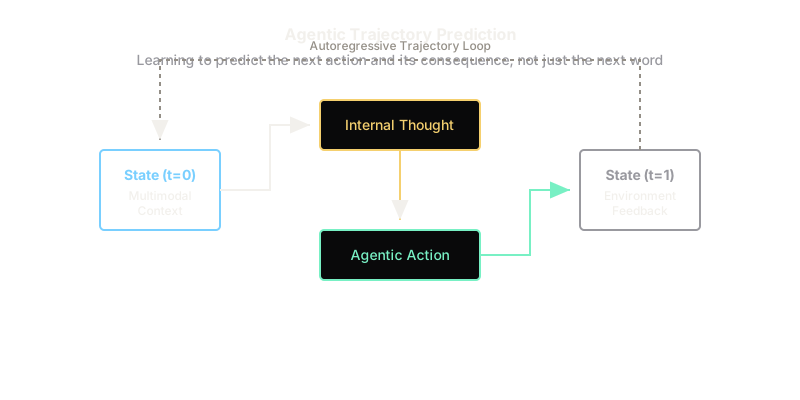
The Problem
While Gemini 1.5 achieved massive context windows (up to 2M tokens) and strong general multimodal capabilities, interacting natively with physical world data (like complex diagrams, UI elements, and robotic sensor data) remained challenging. Models often treated images merely as visual context rather than structural data to be reasoned over step-by-step. Building truly autonomous agentic workflows required a model that could not just "see" an image, but "understand" the spatial and hierarchical relationships within it perfectly.
The Idea
Gemini 2.5 (as described in early technical communications and updates) focused heavily on upgrading the model's innate spatial reasoning and agentic planning capabilities. Instead of relying purely on scaling up the parameter count, the team implemented architectural tweaks to the cross-attention mechanisms specifically tailored for high-resolution, complex spatial graphs, and trained heavily on synthetic trajectories of agentic problem-solving.
How It Works
Native Spatial Encoding Gemini models are natively multimodal from the ground up (they do not stitch together a separate vision encoder and language model after pre-training). Gemini 2.5 pushed this further by upgrading the visual encoding resolution and introducing dynamic patch allocation for highly detailed spatial regions (like text in a UI or small parts of a diagram).
Agentic Trajectory Training
A significant part of the training recipe shifted from standard next-token prediction on static text to predicting actions in a trajectory. The model was trained on millions of episodes of:
[State] -> [Thought] -> [Action] -> [New State] -> [Reward]
This allowed the model to act as a more reliable autonomous agent (e.g., for coding tasks, web browsing, or data analysis) without needing complex external scaffolding frameworks.
Enhanced Code and Math Reasoning By fine-tuning on vast amounts of verified code execution traces (where the model not only sees the code but the resulting execution state and errors), the model's ability to debug and build complex software autonomously reached new heights.
Why It Mattered
Gemini 2.5 demonstrated that the next frontier of model improvement wasn't just "more data", but specifically "better reasoning trajectories". It transformed the LLM from a passive answering engine into an active participant capable of executing complex, multi-step workflows over long time horizons.
What Came After
The advancements in Gemini 2.5 rapidly accelerated the adoption of AI agents in software engineering (e.g., deeply integrated IDE assistants) and complex enterprise automation.