Paper breakdown
Going Deeper with Convolutions
GoogLeNet introduced the Inception module, enabling networks to grow significantly deeper and wider while maintaining a strictly constrained computational budget.
Paper: Going Deeper with Convolutions
Authors: Christian Szegedy, Wei Liu, Yangqing Jia, Pierre Sermanet, Scott Reed, Dragomir Anguelov, Dumitru Erhan, Vincent Vanhoucke, Andrew Rabinovich · 2014
Read the paper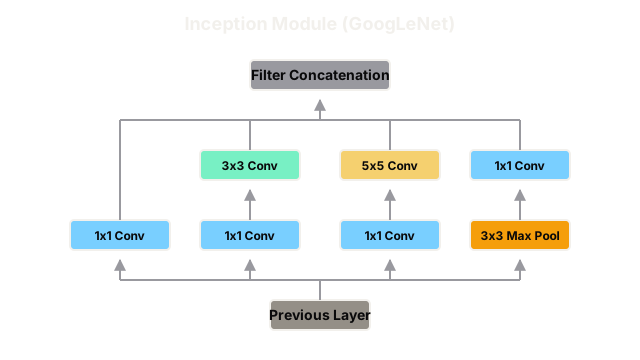
The Problem
In the early days of deep learning, improving a model's accuracy usually meant making it bigger—increasing the number of layers (depth) or the number of units per level (width). However, naive scaling leads to two severe problems: an explosion in the number of parameters, which makes the network highly prone to overfitting (especially with limited data), and a dramatic increase in the use of computational resources. The challenge was figuring out how to massively increase network capacity without blowing up the compute budget.
The Idea
The authors drew inspiration from the theoretical premise that an optimal artificial neural network could be constructed by clustering neurons into sparse, localized sub-networks. Because hardware is optimized for dense matrix multiplication, they approximated this sparse structure using densely computed "Inception modules." Instead of deciding upfront whether a layer should be a 1x1, 3x3, or 5x5 convolution, the Inception module applies all of them in parallel and concatenates their outputs, letting the network learn which pathways are most useful.
How It Works
The GoogLeNet architecture (the specific 22-layer incarnation of the Inception architecture) relies on specialized micro-architectures:
The Inception Module: A single module processes the input through four parallel pathways: a 1x1 convolution, a 3x3 convolution, a 5x5 convolution, and a 3x3 max pooling operation. The outputs of these parallel paths are stacked together along the channel dimension.
Dimensionality Reduction: To keep computational costs from exploding across these parallel operations, 1x1 convolutions are aggressively used before the expensive 3x3 and 5x5 operations. These 1x1 layers act as dimensionality reduction bottlenecks, drastically shrinking the number of input channels before spatial filtering occurs.
Auxiliary Classifiers: Because the network is extremely deep, the gradient signal used for training tends to vanish by the time it reaches the early layers. To combat this, GoogLeNet branches off auxiliary classifiers in the middle of the network during training, injecting additional gradient signals directly into the earlier stages.
Why It Mattered
GoogLeNet won the 2014 ILSVRC challenge, decisively proving that careful architectural design could trump brute-force parameter scaling. Despite being 22 layers deep, GoogLeNet used roughly 12 times fewer parameters than the two-year-older AlexNet, and significantly less compute than its contemporary rival, VGG. It shifted the field's focus from simply stacking convolutions to engineering sophisticated, hyper-efficient layer topologies.
What Came After
The Inception architecture spawned numerous iterations (Inception-v2, v3, v4), continually refining the modules by factoring large convolutions into smaller, asymmetric ones (e.g., replacing a 5x5 with two 3x3s). Ultimately, the ideas of multi-branch architectures and bottleneck dimensionality reduction merged with residual networks to create Inception-ResNet, heavily influencing the design of modern efficient networks like MobileNet.