Improving Language Understanding by Generative Pre-Training
Showed that training a Transformer language model on unlabeled text, followed by task-specific fine-tuning, dramatically improves performance across NLP tasks.
Paper: Improving Language Understanding by Generative Pre-Training
Authors: Alec Radford, Karthik Narasimhan, Tim Salimans, Ilya Sutskever · 2018
Read the paper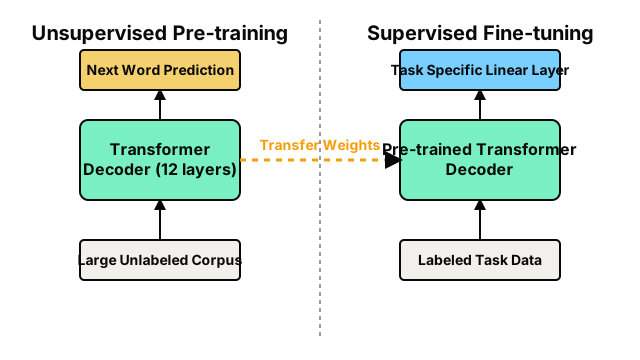
The Problem
Historically, most natural language processing tasks relied on heavily supervised learning, requiring massive, manually annotated datasets specific to each task (like sentiment analysis or question answering). While unlabeled text was abundant, the field lacked a reliable, unified method to leverage this unstructured data to learn generalized linguistic representations that could be easily transferred to downstream tasks.
The Idea
The authors hypothesized a two-stage process: first, use a massive corpus of unlabeled text to train a high-capacity model to predict the next word (generative pre-training). Second, take this pre-trained model and fine-tune it on specific tasks with small supervised datasets. Crucially, they chose the Transformer decoder architecture for this process, betting that its self-attention mechanism would capture long-range linguistic structures better than recurrent networks.
How It Works
The architecture relies heavily on the Transformer decoder, replacing traditional RNN/LSTM structures.
Unsupervised Pre-training: The model is trained on a large corpus of text (the BooksCorpus) with a standard language modeling objective: given a sequence of preceding words, predict the next word. The multi-layer Transformer decoder uses masked self-attention to process the sequence, ensuring that the prediction for a given position only depends on known prior context.
Supervised Fine-tuning: Once the model understands language structure from pre-training, its parameters are adapted for specific supervised tasks. The authors append task-specific linear classifiers onto the final Transformer layer. To handle diverse tasks (like multiple choice or textual entailment) without changing the core architecture, they use traversal-style input transformations—converting structured inputs into contiguous sequences of tokens separated by special delimiter tokens.
Why It Mattered
This paper laid the foundation for the entire Generative Pre-trained Transformer (GPT) lineage. It proved that a single, unified architecture could achieve state-of-the-art results across highly disparate NLP benchmarks, heavily reducing the need for task-specific custom architectures and massive labeled datasets. It effectively kicked off the modern era of Large Language Models (LLMs).
What Came After
GPT-1 proved the concept, but OpenAI quickly scaled up the approach. This led directly to GPT-2, which demonstrated strong zero-shot task transfer capabilities, and then to GPT-3, which scaled the architecture to 175 billion parameters to enable reliable in-context learning. This fundamental pre-train-then-fine-tune paradigm remains the bedrock of modern foundation models.