Identity Preference Optimization (IPO)
A general theoretical paradigm that frames LLM alignment as game-theoretic preference optimization, fixing DPO's overfitting issues with a simpler regularized objective.
Paper: A General Theoretical Paradigm to Understand Learning from Human Preferences
Authors: Mohammad Gheshlaghi Azar, Mark Rowland, Bilal Piot, Daniel Guo, Daniele Calandriello, Michal Valko, Rémi Munos · 2023
Read the paper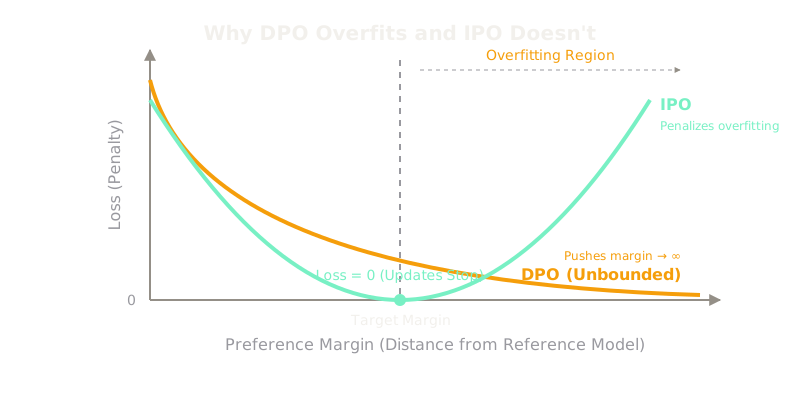
The Problem
Direct Preference Optimization (DPO) revolutionized LLM alignment by eliminating the need for a separate reward model and reinforcement learning loop. However, DPO suffers from a critical flaw: it is prone to overfitting.
Because DPO relies on the Bradley-Terry model for preferences, its loss function essentially tries to push the likelihood of the "chosen" response to 1 and the "rejected" response to 0. In practice, this means the model can drift too far from its original pre-training distribution (the reference model), leading to degenerate text generation and a loss of general capabilities. DPO lacks a strong mechanism to say "you've learned the preference enough, stop updating."
The Idea
The authors introduced a broader theoretical framework called PO (where represents a general mapping function for preferences) that frames alignment not just as reward maximization, but as finding a Nash equilibrium in a game of preferences.
From this framework, they derived Identity Preference Optimization (IPO). By replacing DPO's specific loss function with an identity mapping (a simple mean squared error objective), IPO directly bounds how far the model's policy can diverge from the reference model. It optimizes for human preferences without inherently pushing the probability margins to infinity.
How It Works
IPO operates directly on preference data (chosen vs. rejected pairs), much like DPO, but with a modified mathematical objective:
1. The Preference Gap: Like DPO, the model calculates the implicit reward difference between the chosen and rejected responses using its own probabilities, compared to the frozen reference model.
2. The Regularized Objective: Instead of a logistic loss that scales unboundedly, IPO uses a root-finding / mean squared error formulation. It penalizes the model when the gap between the chosen and rejected likelihoods diverges too far from a target margin.
3. Bounded Updates: Because of this identity mapping, once the model has sufficiently learned that the chosen response is better than the rejected response, the loss flattens out. The gradients shrink, preventing the model weights from updating further into over-optimized, degenerate states.
Why It Mattered
IPO provided a rigorous mathematical foundation that explained why DPO was overfitting and offered a drop-in replacement that was just as easy to train but far more stable. It proved that alignment doesn't require assuming a perfect scalar reward (which fails on cyclic or intransitive human preferences like "A > B > C > A"), paving the way for game-theoretic approaches like Direct Nash Optimization (DNO).
What Came After
IPO spurred the development of alternative direct alignment algorithms that prioritize stability and robustness. It directly influenced approaches like KTO (Kahneman-Tversky Optimization) and Direct Nash Optimization (DNO), which further extended the game-theoretic Nash equilibrium concept to handle complex, non-scalar human preferences that traditional RLHF and DPO simply cannot capture.