Paper breakdown
Direct Preference Optimization (DPO)
The 2023 Stanford paper that revolutionized LLM alignment by mathematically proving you can skip the complex Reward Model and PPO phases of RLHF, aligning models directly from preference data.
Paper: Direct Preference Optimization: Your Language Model is Secretly a Reward Model
Authors: Rafael Rafailov, Archit Sharma, Eric Mitchell, Stefano Ermon, Christopher D. Manning, Chelsea Finn · 2023
Read the paper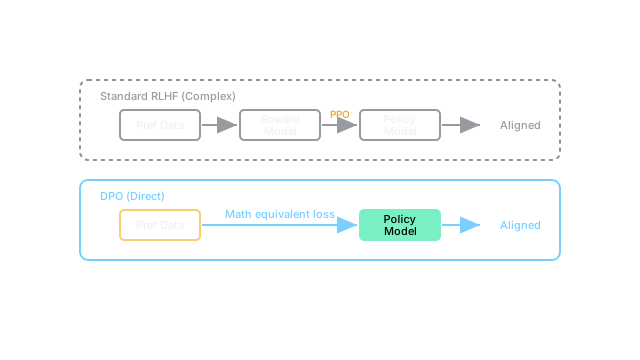
The Problem
Reinforcement Learning from Human Feedback (RLHF) was the standard for aligning models (making them helpful and harmless). However, RLHF is notoriously unstable and complex. It requires training a separate Reward Model, then using a delicate Reinforcement Learning algorithm (like PPO) to train the main model while keeping a third "reference model" in memory to prevent the main model from degrading. This required massive engineering overhead and was highly sensitive to hyperparameters.
The Idea
The authors made a profound mathematical discovery: the math governing the Reward Model and the math governing the optimal policy (the LLM) are actually two sides of the same equation. Because of this, you don't need a separate Reward Model at all. You can mathematically rearrange the RL objective so that the language model itself acts as the reward model. You can directly optimize the LLM on the human preference data using a simple, stable classification loss.
How It Works
DPO simplifies alignment to a single step:
- The Data: You start with a dataset of prompts, where each prompt has a "chosen" (good) response and a "rejected" (bad) response.
- The Loss Function: For a given prompt, the LLM calculates the probability it would generate the "chosen" response, and the probability it would generate the "rejected" response.
- Optimization: The DPO loss function directly updates the model's weights to increase the probability of the chosen response and decrease the probability of the rejected response. It also includes a penalty term (using a frozen reference model) to ensure the model doesn't drift too far from its base language capabilities.
There is no separate reward model, no PPO, and no reinforcement learning loop.
Why It Mattered
DPO radically democratized alignment. Suddenly, anyone with a GPU could align an open-source model just by running a standard fine-tuning script on a preference dataset. It replaced RLHF as the default alignment method in the open-source community almost overnight, powering hundreds of top models on the Hugging Face leaderboard.
What Came After
DPO sparked a massive wave of research into "offline alignment" methods. Variants like ORPO (Odds Ratio Preference Optimization) and KTO (Kahneman-Tversky Optimization) were developed to further simplify the process or remove the need for strict "chosen/rejected" pairs, relying instead on simple thumbs-up/thumbs-down data.