Paper breakdown
Mask R-CNN
A conceptually simple, flexible, and general framework for object instance segmentation that dominated computer vision for years.
Paper: Mask R-CNN
Authors: Kaiming He, Georgia Gkioxari, Piotr Dollár, Ross Girshick · 2017
Read the paper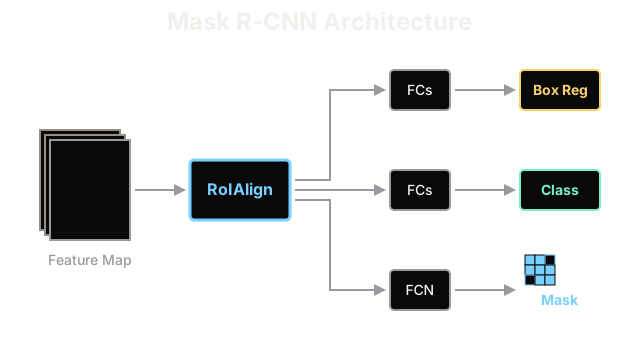
The Problem
Prior to Mask R-CNN, object detection (drawing bounding boxes around objects) had made significant strides with architectures like Faster R-CNN. However, instance segmentation—the task of predicting the exact pixel-level mask of each individual object in an image—remained difficult. Existing methods were often slow, complex pipelines that struggled to smoothly integrate object classification, bounding box regression, and pixel-level segmentation into a single, cohesive neural network.
The Idea
The authors extended the highly successful Faster R-CNN object detection framework by simply adding a new, parallel branch. While the existing branches predicted the bounding box and the class of an object, the new branch predicted a binary mask for the pixels inside that bounding box.
How It Works
Mask R-CNN builds directly on top of Faster R-CNN, operating in two stages.
Stage 1: Proposal Generation: A Region Proposal Network (RPN) scans the image and proposes candidate object bounding boxes (Regions of Interest, or RoIs).
RoIAlign: To predict pixel-accurate masks, the features extracted from the image must align perfectly with the original pixels. The previous method (RoIPool) used aggressive quantization (rounding), which misaligned features and ruined mask quality. Mask R-CNN introduced RoIAlign, which uses bilinear interpolation to extract perfectly aligned features without rounding errors.
Stage 2: Parallel Prediction: The aligned features are fed into three parallel branches. Two branches output the object class and bounding box offset (just like Faster R-CNN). The third branch is a small Fully Convolutional Network (FCN) that outputs a spatial mask for the object, completely independently of the class prediction.
Why It Mattered
Mask R-CNN proved that instance segmentation could be solved elegantly by decoupling the mask prediction from the class prediction and using pixel-accurate feature alignment. It was fast, easy to train, and remarkably flexible, easily generalizing to other tasks like human pose estimation (keypoint detection) by simply swapping out the mask branch. It swept the COCO challenges and became the undisputed baseline for instance segmentation.
What Came After
Mask R-CNN served as the foundation for nearly all instance segmentation research for the next half-decade. Its core component, RoIAlign, became standard in object detection architectures. While transformer-based architectures (like DETR) and segmentation foundational models (like Segment Anything) eventually introduced new paradigms, Mask R-CNN's architecture remained widely used in industry for its reliability and efficiency.