Paper breakdown
Masked Autoencoders Are Scalable Vision Learners
MAE proved that masking random patches of an image and reconstructing them is a highly scalable and effective method for self-supervised computer vision.
Paper: Masked Autoencoders Are Scalable Vision Learners
Authors: Kaiming He, Xinlei Chen, Saining Xie, Yanghao Li, Piotr Dollár, Ross Girshick · 2021
Read the paper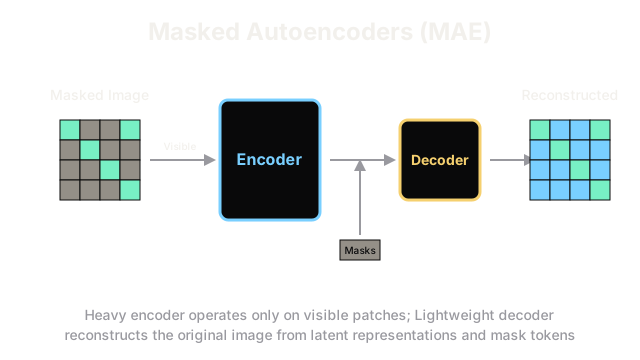
The Problem
In Natural Language Processing, self-supervised learning using masked language modeling (like BERT) was hugely successful. Researchers wanted to replicate this success in computer vision by masking parts of an image and training a model to predict the missing pieces. However, early attempts were computationally expensive and didn't scale well, often relying on complex pixel-level reconstruction losses or operating on dense, unmasked images during the encoder phase.
The Idea
Masked Autoencoders (MAE) proposed a beautifully simple asymmetric encoder-decoder architecture. The key insight was that images possess heavy spatial redundancy. By masking out a massive portion of the image (e.g., 75% of the patches) and entirely dropping those masked patches from the encoder, the model is forced to learn deep semantic representations to solve the difficult reconstruction task, while running significantly faster.
How It Works
The MAE architecture builds directly upon the Vision Transformer (ViT).
Patching and Masking: The input image is divided into a grid of non-overlapping patches. A high percentage (usually 75%) of these patches are randomly masked out.
Asymmetric Encoder: The encoder only processes the visible, unmasked patches. Because it drops 75% of the data, the encoder can be extremely large (like a ViT-Huge) and still run incredibly efficiently.
Lightweight Decoder: The decoder takes the rich latent representations produced by the encoder and combines them with learnable "mask tokens" that represent the missing patches. The decoder is purposely kept small and lightweight. It attempts to reconstruct the original pixel values of the masked patches.
Why It Mattered
MAE dramatically reduced the training time and memory footprint of self-supervised vision models, allowing researchers to train much larger models on much larger datasets. It achieved state-of-the-art results on ImageNet and demonstrated excellent transfer learning capabilities to other tasks like object detection and segmentation, proving that the masked-prediction paradigm was just as powerful for vision as it was for language.
What Came After
The success of MAE solidified the Vision Transformer as the dominant architecture for self-supervised vision tasks. It spawned numerous follow-up works adapting the masked modeling paradigm to video, 3D point clouds, and audio, heavily influencing the development of foundation models for multimodal data.