MobileNets: Efficient Convolutional Neural Networks for Mobile Vision Applications
Introduced depthwise separable convolutions to drastically reduce the computational cost and model size of vision networks, enabling on-device ML.
Paper: MobileNets: Efficient Convolutional Neural Networks for Mobile Vision Applications
Authors: Andrew G. Howard, Menglong Zhu, Bo Chen, Dmitry Kalenichenko, Weijun Wang, Tobias Weyand, Marco Andreetto, Hartwig Adam · 2017
Read the paper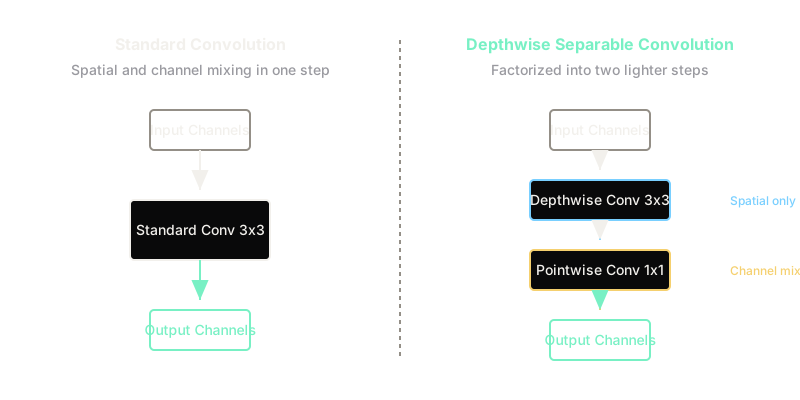
The Problem
Before MobileNets, state-of-the-art vision models like VGG and ResNet were becoming increasingly deeper and more complex. While this drove up accuracy, it also led to massive parameter counts and heavy computational requirements (measured in Multiply-Accumulates, or MACs). These models were impossible to run efficiently on mobile devices or edge hardware with strict latency and battery constraints. The standard approach—simply shrinking the network by removing layers or channels—often resulted in unacceptable accuracy drops.
The Idea
The core insight of MobileNets was to replace standard convolutions with depthwise separable convolutions. A standard convolution filters and combines inputs into a new set of outputs in a single step, which is computationally expensive. Howard et al. realized they could factorize this process into two separate, lighter operations: a depthwise convolution for spatial filtering, and a 1x1 pointwise convolution for channel combination.
How It Works
Standard Convolution Bottleneck A standard convolutional layer takes an input tensor of size (where is spatial width/height and is input channels) and applies filters of size . The computational cost is . Because it densely connects every input channel to every output channel while also looking at the spatial window, the cost scales multiplicatively.
Depthwise Separable Factorization MobileNets split this into two parts:
- Depthwise Convolution: Applies a single filter to each input channel separately. It learns spatial patterns but doesn't mix channels. Cost: .
- Pointwise Convolution: Applies a convolution across all channels. It learns how to linearly combine the channels, completely ignoring spatial layout. Cost: .
This factorization reduces the computational cost by a factor of roughly . For a standard convolution, this means a reduction of 8-9x in computation with only a minor reduction in accuracy.
Width and Resolution Multipliers To give developers control over the latency-accuracy trade-off, MobileNets introduced two hyperparameters:
- Width Multiplier (): Thins the network uniformly at each layer by a factor of , reducing the number of input and output channels.
- Resolution Multiplier (): Reduces the input image resolution, which proportionally drops computation across all layers.
Why It Mattered
MobileNets proved that you could run deep learning models directly on mobile devices without relying on cloud computation. By drastically lowering the computational baseline, it made real-time on-device tasks—like face detection, object recognition, and augmented reality—practical for the first time. It shifted the architectural paradigm from just "how accurate can we get?" to "how efficient can we get?"
What Came After
MobileNets directly spawned a lineage of efficient architectures, including MobileNetV2 (which added inverted residuals and linear bottlenecks) and MobileNetV3 (which added squeeze-and-excitation modules and neural architecture search). It also inspired other efficient families like EfficientNet, and the general principle of depthwise separable convolutions became a staple in modern lightweight models.