Neural Style Transfer
The seminal paper that separated image content from artistic style using deep convolutional networks, enabling automated style transfer without spatial constraints.
Paper: A Neural Algorithm of Artistic Style
Authors: Leon A. Gatys, Alexander S. Ecker, Matthias Bethge · 2015
Read the paper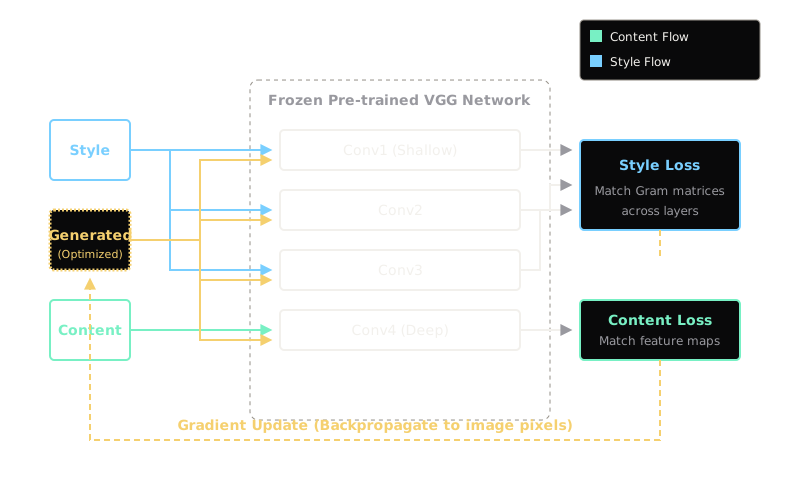
The Problem
Before this paper, applying the visual style of one image to the structural content of another usually required hand-crafted features or strict spatial correspondence (like texture synthesis). There was no general, automated way to disentangle the high-level semantic "content" of an image from its low-level texture and colour "style" using neural networks.
The Idea
The authors realized that deep convolutional neural networks (specifically VGG-19) already naturally separate content and style representations across their layers. The higher layers capture the abstract arrangement of objects (content), while the spatial correlations between different filter responses in the lower layers capture the texture and colour palette (style). By optimizing a random noise image to match the content features of one image and the style features of another, the network can synthesize a new image combining the two.
How It Works
Content Representation
A Content Image is passed through a pre-trained VGG network. The feature maps from a deep layer (e.g., conv4_2) are extracted. These maps represent the high-level semantic content, discarding exact pixel values.
Style Representation
A Style Image is passed through the same network. Feature maps are extracted from multiple layers (from shallow to deep). For each layer, the spatial correlations between different filters are computed using a Gram Matrix. This discards all spatial arrangement but captures the "texture" — which features tend to co-occur (e.g., if "brush stroke" and "blue" fire together).
Image Optimization
Instead of training the network weights, the algorithm optimizes the actual pixels of a Generated Image (usually initialized as white noise). The image is passed through the network, and a total loss is calculated:
- Content Loss: Mean squared error between the generated image's deep features and the content image's deep features.
- Style Loss: Mean squared error between the generated image's Gram matrices and the style image's Gram matrices across multiple layers.
The gradients are backpropagated through the frozen network all the way down to the input image pixels, iteratively updating the image until it minimizes both losses.
Why It Mattered
This paper demonstrated that neural networks don't just memorize pixels; they learn factorized representations of visual data. It launched the entire field of neural style transfer, popularized the use of Gram matrices for texture modeling, and established the technique of optimizing image pixels directly through a frozen, pre-trained network via backpropagation.
What Came After
While this original optimization process was slow (requiring hundreds of gradient steps per image), it directly inspired fast style transfer networks (like those by Johnson et al. and Ulyanov et al.), which trained feed-forward networks to apply styles in a single pass. It also paved the way for Adaptive Instance Normalization (AdaIN) for arbitrary style transfer, and heavily influenced later generative models by showing how to leverage pre-trained feature extractors (like perceptual loss).