Paper breakdown
Very Deep Convolutional Networks for Large-Scale Image Recognition
VGG proved that increasing depth using homogeneous 3x3 convolutional filters was crucial for improving accuracy in image recognition.
Paper: Very Deep Convolutional Networks for Large-Scale Image Recognition
Authors: Karen Simonyan, Andrew Zisserman · 2014
Read the paper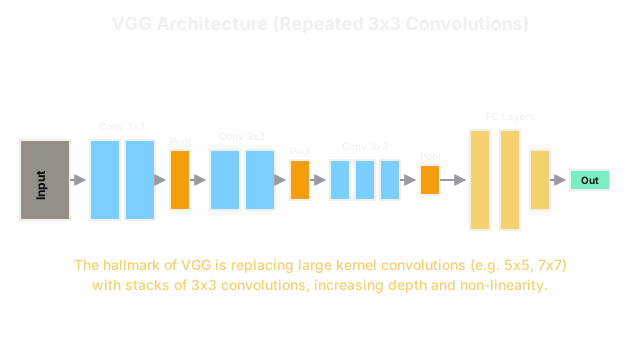
The Problem
Following the breakthrough success of AlexNet in 2012, researchers knew Convolutional Neural Networks (CNNs) were the future of computer vision. However, there was no consensus on how to improve the architecture. Early models used a confusing mix of large filter sizes (like 11x11 or 7x7) and aggressive pooling layers to quickly reduce spatial dimensions. The design space for CNNs was vast and ad hoc, and it was entirely unclear what specific architectural parameter—depth, width, or filter size—was most responsible for driving higher accuracy.
The Idea
The authors hypothesized that the most critical factor for performance was the depth of the network, but to push networks deeper, they needed to simplify the building blocks. They proposed abandoning large convolutional filters entirely, instead building exceptionally deep networks (up to 19 layers) using exclusively tiny, homogeneous 3x3 filters applied consecutively.
How It Works
The VGG architecture is defined by its strict uniformity and simplicity:
Stacking 3x3 Convolutions: The core mechanism relies on the mathematical property that a stack of two 3x3 convolutional layers has the same effective receptive field as a single 5x5 layer, and a stack of three equates to a 7x7 layer. By using multiple smaller filters, the network achieves the same spatial coverage but with significantly fewer parameters and the benefit of additional non-linear activation functions (ReLUs) between each layer.
Uniform Architecture: The network is divided into sequential blocks. Within each block, a series of 3x3 convolutions (with stride 1 and padding 1 to preserve spatial dimensions) is applied. At the end of each block, a 2x2 max-pooling layer halves the spatial dimensions, while the number of channels is typically doubled.
Deep Scaling: By standardizing this simple block structure, the researchers were able to cleanly scale the network from 11 up to 19 weight layers (yielding the famous VGG-16 and VGG-19 variants), systematically evaluating how depth impacted performance without conflating variables.
Why It Mattered
VGG demonstrated decisively that depth is a crucial component for representational power. It secured second place in the 2014 ILSVRC classification task, but its true legacy was its simplicity and transferability. The feature representations extracted by pre-trained VGG networks were remarkably robust and became the gold standard baseline for almost every subsequent computer vision task, from object detection to neural style transfer.
What Came After
While highly accurate, VGG models were computationally expensive and bloated with parameters (over 130 million). Its limitations forced researchers to rethink how to go deeper without exploding parameter counts. This directly motivated the development of ResNet, which introduced residual connections to allow models to scale to hundreds of layers, permanently altering the trajectory of computer vision architectures.