Image-to-Image Translation with Conditional Adversarial Networks
Pix2Pix introduced a general-purpose framework for image-to-image translation using conditional GANs, replacing task-specific hand-engineered loss functions.
Paper: Image-to-Image Translation with Conditional Adversarial Networks
Authors: Phillip Isola, Jun-Yan Zhu, Tinghui Zhou, Alexei A. Efros · 2017
Read the paper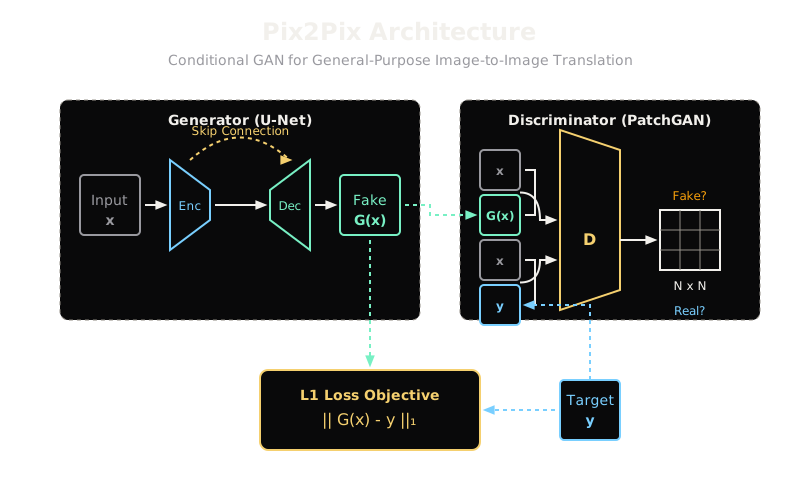
The Problem
Before Pix2Pix, transforming an image from one domain to another (e.g., converting a sketch to a photo, or a daytime scene to nighttime) required building specialized, hand-crafted loss functions for each specific task. Traditional approaches often relied solely on minimizing Euclidean distance (like L1 or L2 loss) between predicted and target pixels. This produced blurry results because minimizing average pixel error naturally leads the network to output safe, desaturated averages of all plausible outcomes, failing to capture sharp, high-frequency details.
The Idea
The authors realized that instead of hand-engineering a loss function to tell the network how a specific task should look, they could use a Generative Adversarial Network (GAN) to learn the loss function automatically. By conditioning the GAN on the input image, the network learns a general-purpose mapping from input to output. The generator tries to produce realistic outputs that fool the discriminator, while the discriminator is trained to distinguish between real target images and the generator's fake outputs, given the input image as context.
How It Works
Pix2Pix frames image-to-image translation as a conditional GAN (cGAN) problem, with two major architectural innovations:
The U-Net Generator Instead of a standard encoder-decoder that bottlenecks all information through a compressed latent representation, Pix2Pix uses a U-Net architecture. Because many image translation tasks (like colorization) share low-level structural information between input and output, the U-Net adds skip connections directly bridging the encoding and decoding layers. This allows the network to bypass the bottleneck and perfectly preserve spatial details from the input.
The PatchGAN Discriminator Rather than classifying the entire image as real or fake with a single scalar value, the Pix2Pix discriminator uses a "PatchGAN" architecture. It penalizes structure at the scale of patches, classifying each patch of the image as real or fake. This approach explicitly models high-frequency details (textures and sharp edges) while relying on a standard L1 loss to enforce low-frequency correctness (overall structure and color). PatchGAN has fewer parameters, runs faster, and can be applied to images of arbitrary size.
The Combined Objective The final loss function combines the adversarial cGAN loss with a traditional L1 loss. The adversarial loss forces the generated images to look crisp and realistic, while the L1 loss ensures the overall structure matches the target output.
Why It Mattered
Pix2Pix proved that a single, unified architecture could achieve state-of-the-art results across a vast array of previously disjoint image-to-image translation tasks—from generating maps from aerial photos to creating realistic street scenes from semantic labels. It demonstrated that adversarial training is a powerful, general-purpose tool for structured prediction problems where the output space is highly complex and multi-modal.
What Came After
Pix2Pix laid the groundwork for an explosion of GAN-based image translation research. It was directly succeeded by CycleGAN (also co-authored by Jun-Yan Zhu), which extended the concept to unpaired image translation, removing the need for strictly matched input-output datasets. The PatchGAN discriminator and adversarial-plus-L1 objective became standard components in high-fidelity generative pipelines like GauGAN and various deepfake technologies.