RWKV
Introduced a linear attention architecture that trains in parallel like a Transformer but performs inference as an efficient RNN with a fixed state.
Paper: RWKV: Reinventing RNNs for the Transformer Era
Authors: Bo Peng, Eric Alcaide, Quentin Anthony, Alon Albalak, Samuel Arcadinho, Huanqi Cao, Xin Cheng, Michael Chung, Matteo Grella, Kranthi Kiran GV, Xuzhao He, Haowen Hou, Przemyslaw Kazienko, Jan Kocon, Jiaming Kong, Bartlomiej Koptyra, Hayden Lau, Krishna Sri Ipsit Mantri, Ferdinand Mom, Atsushi Saito, Xiangru Tang, Bolun Wang, Johan S. Wind, Stansilaw Wozniak, Ruichong Zhang, Zhenyuan Zhang, Qihang Zhao, Peng Zhou, Jian Zhu, Rui-Jie Zhu · 2023
Read the paper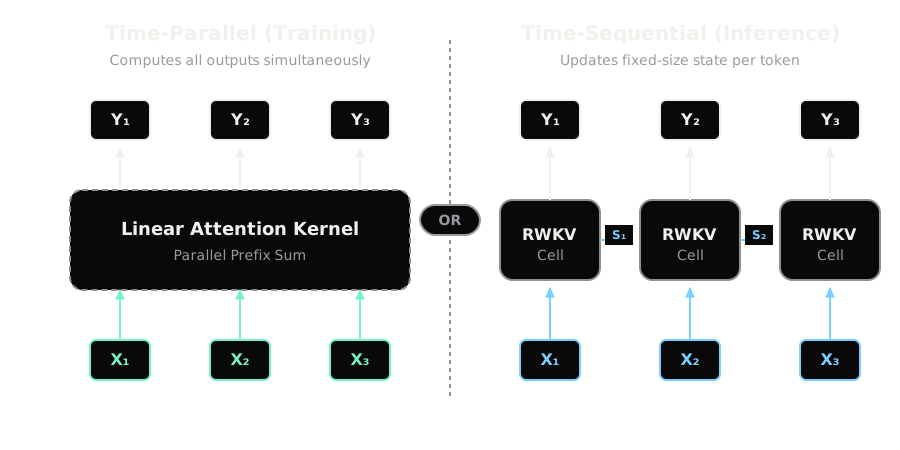
The Problem
Standard Transformers scale quadratically with sequence length because their attention mechanism requires every token to attend to every other token. This causes the memory footprint (the KV cache) and computational cost to explode during inference for long contexts.
Recurrent Neural Networks (RNNs) solve this inference bottleneck by compressing all past context into a fixed-size hidden state, achieving constant memory and linear time scaling. However, RNNs suffer from a different fatal flaw: they must be trained sequentially. Because the state at step depends on the state at step , RNNs cannot take advantage of the massive parallel compute capabilities of modern GPUs during training, which fundamentally prevented them from scaling to billions of parameters.
The Idea
The authors of RWKV (Receptance Weighted Key Value) realized that by reformulating the attention mechanism to remove the standard softmax over the sequence, the model could be expressed as a linear equation.
This specific linear formulation has a remarkable mathematical property: it can be calculated in two entirely different but perfectly equivalent ways. During training, it can be computed as a "Time-Parallel" linear attention mechanism (like a Transformer), allowing simultaneous processing of the entire sequence. During inference, it can be mathematically rearranged into a "Time-Sequential" state update (like an RNN), eliminating the need for a KV cache.
How It Works
The architecture replaces the standard Multi-Head Attention with the Time-Mixing block, and standard Feed-Forward networks with a Channel-Mixing block.
-
Receptance, Weight, Key, Value: Instead of Q, K, and V, RWKV uses four learned vectors for each token:
- R (Receptance): Acts as the "receiver," determining how much past information the current token needs.
- W (Weight): A positional decay factor that controls how quickly past information fades.
- K (Key) & V (Value): Similar to a Transformer, they represent the token's identity and semantic content.
-
Time-Parallel Mode (Training): The network computes the output for all tokens simultaneously. The attention score between any two tokens is determined by their distance (using the exponential decay ). Because it avoids the non-linear softmax operation across tokens, the sequence can be processed in parallel using specialized custom CUDA kernels.
-
Time-Sequential Mode (Inference): When generating text, the exact same equations are rearranged. The model maintains a constant-sized state vector representing the exponentially decayed sum of all past Keys and Values. For each new token, the model simply updates this state using the new token's and , and then uses the new token's to extract the output from the updated state.
Why It Mattered
RWKV proved that it was possible to scale an RNN to the size of a Large Language Model (up to 14 billion parameters) while matching the performance of a similarly sized Transformer.
It completely eliminated the KV cache bottleneck that limits the context window of standard Transformers during inference. Because generation requires only updating a fixed-size state matrix, an RWKV model uses a constant amount of memory whether it is generating the 10th token or the 10,000th token, making it incredibly efficient to run on consumer hardware.
What Came After
The success of RWKV fundamentally shifted the landscape of architecture research by proving that Transformers were not the only viable path to performant LLMs. It directly inspired a wave of "linear attention" and "state space" architectures, most notably Mamba, which further refined the idea of data-dependent state transitions. The RWKV community has continued to iterate, releasing improved versions (like RWKV-v4, v5, and v6) that steadily close the performance gap with the best open-weight Transformers.