Paper breakdown
Efficiently Modeling Long Sequences with Structured State Spaces (S4)
Introduced the Structured State Space (S4) model, enabling the efficient processing of extremely long sequences without the quadratic cost of attention.
Paper: Efficiently Modeling Long Sequences with Structured State Spaces
Authors: Albert Gu, Karan Goel, Christopher Ré · 2021
Read the paper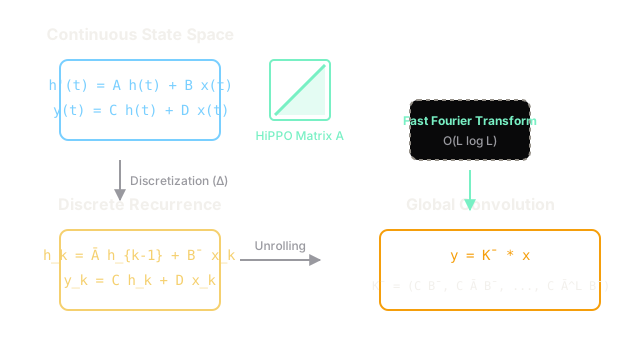
The Problem
Transformers dominated sequence modeling, but their core mechanism—self-attention—scales quadratically with sequence length. This meant Transformers were practically limited to a few thousand tokens, struggling immensely with ultra-long sequences like raw audio, lengthy genomic strands, or full books. Recurrent Neural Networks (RNNs) scale linearly, but they suffer from vanishing gradients and cannot parallelize well during training, making them slow and notoriously bad at remembering very long-range dependencies.
The Idea
The authors revisited State Space Models (SSMs), a classic concept from control theory, and adapted them for deep learning. Standard SSMs were computationally infeasible and unstable for long sequences. The critical breakthrough of the S4 paper was heavily structuring the transition matrices of the SSM—specifically using the HiPPO (High-order Polynomial Projection Operators) initialization. By forcing the matrix into a specific structured format (Normal Plus Low-Rank), they created a model that could be computed incredibly efficiently while perfectly preserving historical context over tens of thousands of steps.
How It Works
S4 represents a sequence using a continuous-time linear state space model, which maps a 1D input signal to a 1D output signal through an implicit latent state.
- Dual Representation: Due to its linear formulation, S4 can be computed in two entirely different ways. During training, it acts as a massive convolutional filter that can be applied to the entire sequence simultaneously in time using Fast Fourier Transforms (FFTs).
- Efficient Inference: During autoregressive generation (inference), it can be seamlessly converted into a recurrent neural network (RNN) format, updating its hidden state step-by-step in time and memory per step, completely avoiding the expanding context window problem of Transformers.
- The Structured Matrix: The mathematical magic lies in the structured matrix , which condenses the entire past history of the sequence into a fixed-size state optimally, preventing the memory decay typical of RNNs.
Why It Mattered
S4 achieved state-of-the-art results on the Long Range Arena benchmark, solving tasks like classifying images pixel-by-pixel (sequences of length 16,000+) that completely broke Transformers. It proved that deep learning models could effectively and efficiently model sequence dependencies over radically longer time horizons than previously thought possible, without relying on attention.
What Came After
S4 sparked a massive resurgence of interest in State Space Models as potential successors or complements to the Transformer architecture. It laid the mathematical and conceptual groundwork for subsequent, more flexible SSMs like Mamba, which introduced data-dependent parameters to close the performance gap with Transformers on language modeling while maintaining linear scaling.