Paper breakdown
Outrageously Large Neural Networks: The Sparsely-Gated Mixture-of-Experts Layer
Sparse Mixture of Experts allows neural networks to scale parameters enormously without proportional computational cost by routing inputs to specialized sub-networks.
Paper: Outrageously Large Neural Networks: The Sparsely-Gated Mixture-of-Experts Layer
Authors: Noam Shazeer, Azalia Mirhoseini, Krzysztof Maziarz, Andy Davis, Quoc Le, Geoffrey Hinton, Jeff Dean · 2017
Read the paper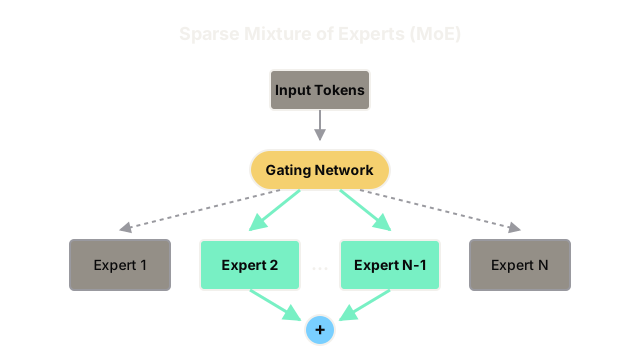
The Problem
Scaling up neural networks reliably improves their performance, but traditional dense architectures require a proportional increase in computational cost: doubling the parameters means doubling the FLOPs required for every single inference pass. To achieve breakthrough performance on complex tasks like machine translation, researchers wanted to train models with billions of parameters, but the computational cost of dense models made such scaling physically and financially impossible.
The Idea
The authors introduced conditional computation via a Sparsely-Gated Mixture-of-Experts (MoE) layer. Instead of activating every parameter for every input, the network uses a learned gating mechanism to dynamically route each input to a small subset of specialized "expert" sub-networks. This decoupling of model capacity from computational cost allows the model size to scale massively while the compute per token remains nearly constant.
How It Works
The MoE layer acts as a drop-in replacement for standard feed-forward layers:
The Experts: The layer contains thousands of independent feed-forward networks (the "experts"). In this paper, up to 137 billion parameters were distributed across thousands of these sub-networks.
The Noisy Top-K Gating Network: For each input representation, a lightweight gating network calculates a probability distribution over all available experts. Crucially, it selects only the Top-K experts (often just K=2 or 4) to process the input. The output is a weighted sum of only those selected experts, bypassing computation for the thousands of unselected ones.
Load Balancing Loss: Left to its own devices, the gating network tends to fall into a rich-get-richer trap, relying on a few favored experts and ignoring the rest. To prevent this, the authors introduced an auxiliary load-balancing loss that heavily penalizes the network if it fails to route inputs evenly across all available experts, ensuring full utilization of the model's massive parameter count.
Why It Mattered
This paper practically invented modern sparse scaling. It demonstrated that a 137-billion parameter model could be trained and run efficiently, maintaining the computational footprint of a much smaller network. It proved that conditional computation was not just a theoretical curiosity, but a viable, necessary architecture for building "outrageously large" models that drastically outperform dense networks on complex tasks.
What Came After
MoE architectures became the hidden engine of modern large language models. The concepts introduced here paved the way for massive sparse models like Google's Switch Transformer and GLaM. Later, the same sparse routing principles were widely adopted in open-weight foundation models like Mixtral 8x7B and are heavily utilized in the closed-source frontier models (like GPT-4) to manage extreme scale efficiently.