WaveNet: A Generative Model for Raw Audio
Pioneered the generation of high-fidelity speech and audio by autoregressively predicting raw audio waveforms sample-by-sample using dilated causal convolutions.
Paper: WaveNet: A Generative Model for Raw Audio
Authors: Aäron van den Oord, Sander Dieleman, Heiga Zen, Karen Simonyan, Oriol Vinyals, Alex Graves, Nal Kalchbrenner, Andrew Senior, Koray Kavukcuoglu · 2016
Read the paper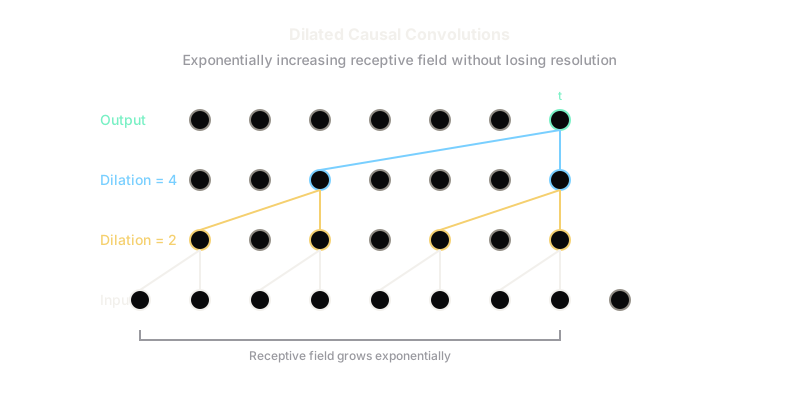
The Problem
Before WaveNet, Text-to-Speech (TTS) systems were highly robotic. They largely relied on concatenative TTS (stitching together short recordings of a human actor) or parametric TTS (using traditional signal processing models to simulate a vocal tract). Both sounded unnatural. The ultimate goal was to generate raw audio directly from a neural network. However, raw audio operates at massive sampling rates (e.g., 16,000 samples per second). An RNN or LSTM processing 16,000 sequential steps for a single second of audio was computationally impossible to train due to vanishing gradients and sequential bottlenecks.
The Idea
DeepMind's WaveNet proposed generating raw audio waveforms directly using autoregressive Convolutional Neural Networks (CNNs) instead of RNNs. To handle the massive temporal context required for audio (a model needs to "hear" hundreds of milliseconds into the past to know what to output next), WaveNet introduced dilated causal convolutions. This allowed the network's receptive field to grow exponentially with depth, capturing long-range temporal dependencies efficiently.
How It Works
Causal Convolutions In a causal convolution, the output at time is computed using only inputs from time and earlier. The model cannot "peek" into the future. It predicts the audio sample at based on all samples up to .
Dilated Convolutions A standard causal CNN would need thousands of layers to look back just one second of audio. WaveNet solves this using dilation.
- Layer 1 looks at adjacent samples (dilation = 1).
- Layer 2 skips 1 sample (dilation = 2).
- Layer 3 skips 3 samples (dilation = 4).
- Layer skips samples. By stacking these layers, the receptive field grows exponentially. A network with just 10 layers can look back 1,024 steps. By repeating these stacks, WaveNet achieves a receptive field of thousands of samples with relatively few parameters.
Softmax over Quantized Values Raw audio is typically represented as a continuous 16-bit integer (65,536 possible values per sample). Predicting this directly as a continuous regression problem was difficult. WaveNet used a -law companding transformation to quantize the audio into 256 distinct values. The model then simply outputs a 256-way softmax distribution for the next sample, treating audio generation as a categorical classification problem.
Why It Mattered
WaveNet was a massive breakthrough in audio AI. It completely shattered the quality ceiling for Text-to-Speech, producing voices that were vastly more natural and human-like than any previous system. It proved that deep learning could model highly complex, high-frequency raw waveforms directly, without relying on hand-crafted acoustic features.
What Came After
WaveNet was rapidly deployed to Google Assistant, becoming one of the fastest translations from fundamental research to massive consumer deployment in AI history. Its architecture (dilated causal convolutions) became a staple for time-series modeling, influencing later models like Parallel WaveNet and MelGAN, which focused on making the generation process faster than real-time.