Paper breakdown
You Only Look Once
Reframed object detection as a single regression problem, allowing a single neural network to predict bounding boxes and classes in real-time.
Paper: You Only Look Once: Unified, Real-Time Object Detection
Authors: Joseph Redmon, Santosh Divvala, Ross Girshick, Ali Farhadi · 2015
Read the paper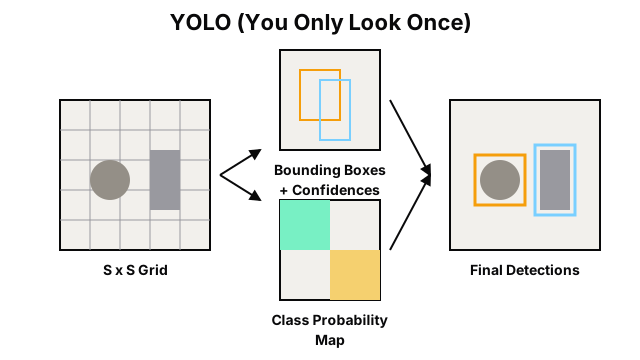
The Problem
Leading object detection systems like Faster R-CNN were highly accurate but fundamentally complex. They operated in multi-stage pipelines: first generating region proposals, then classifying those boxes, and finally refining the bounds. These separate stages had to be trained independently or via complex alternating schedules, and their sheer computational weight made them far too slow for real-time applications like robotics or autonomous driving.
The Idea
Instead of a pipeline of separate modules, YOLO treats object detection as a single regression problem straight from image pixels to bounding box coordinates and class probabilities. The core insight is that a single convolutional neural network can look at the whole image simultaneously, reasoning globally about the full context and all objects present, hence the name: You Only Look Once.
How It Works
YOLO unifies the detection components into a single neural network model:
Grid Division: The system divides the input image into an grid. If the center of an object falls into a grid cell, that grid cell is responsible for detecting that object.
Unified Prediction: Each grid cell predicts a fixed number () of bounding boxes. For each box, it outputs 5 values: , and a confidence score that reflects both the likelihood an object is present and the accuracy of the box.
Class Probabilities: Simultaneously, each grid cell predicts a set of conditional class probabilities (the likelihood of a specific class, given that an object is present).
The Final Output: At test time, the box confidence scores and the class probabilities are multiplied together. This provides a final set of bounding boxes with associated class-specific confidence scores, which are then filtered via non-maximum suppression to produce the final detections.
Why It Mattered
YOLO was remarkably fast, capable of processing images at 45 frames per second (with a faster version hitting 155 fps). Because it saw the entire image during training and testing, it made fewer background errors (false positives on background patches) than proposal-based methods like R-CNN. It proved that end-to-end differentiable architectures could rival multi-stage pipelines in accuracy while vastly outperforming them in speed.
What Came After
YOLO birthed an entire lineage of single-stage object detectors. The original authors released YOLO9000 (YOLOv2) and YOLOv3, incrementally improving accuracy and handling of small objects. The YOLO family tree has since been continued by the broader research community (YOLOv4, YOLOv5, YOLOv8, etc.), establishing the standard architecture for nearly all real-time computer vision deployment today.