Visual explainer
Decision Trees
Follow ten illustrative samples through a Gini-scored split, recursive branches and an unseen-point prediction, then inspect depth and diagonal boundaries.
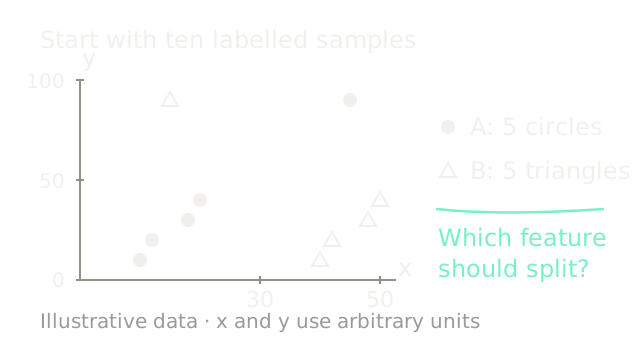
A classification tree predicts a class by following feature comparisons to a leaf. These ten illustrative samples have two numeric features, x and y, and classes A and B. Their coordinates stay fixed through the split diagrams; the shapes identify classes independently of colour.
One Question, One Cut
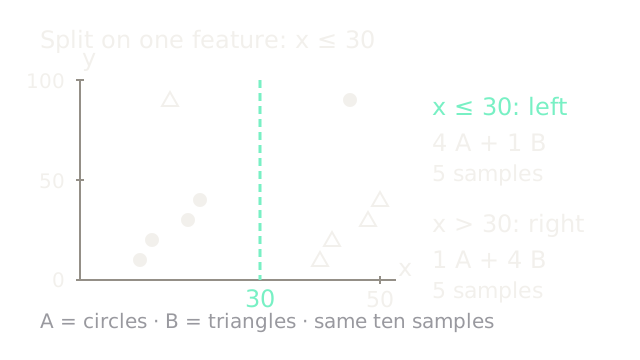
The x threshold partitions the samples into a left child containing 4 A and 1 B, and a right child containing 1 A and 4 B. Equality goes left. This axis-aligned split tests one feature; it doesn't yet separate every class.
Impurity Falls 0.18
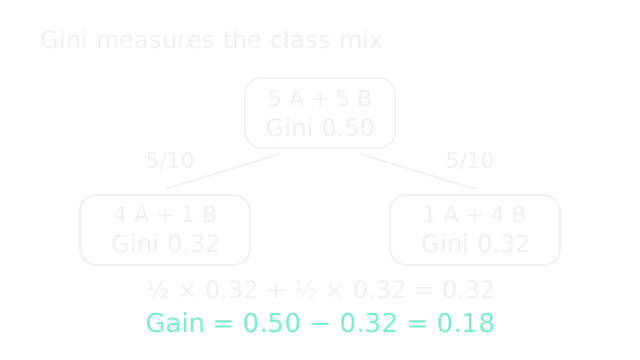
Gini impurity is one minus the sum of squared class proportions. The root gives 1 − 0.5² − 0.5² = 0.50. Each child gives 1 − 0.8² − 0.2² = 0.32. Weighting children by their sample counts gives 0.32, a reduction of 0.18. A greedy tree picks the candidate with the lowest weighted child impurity.
Recurse Inside Each Child
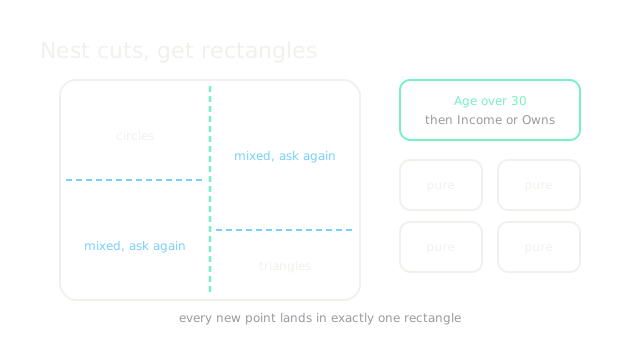
Apply y ≤ 50 inside each child. Four leaves contain 4 A, 1 B, 4 B and 1 A. There are three split nodes, but a sample encounters only two comparisons. The chosen threshold lies between observed y values 40 and 90; it isn't a claimed library fit.
Trace a New Point
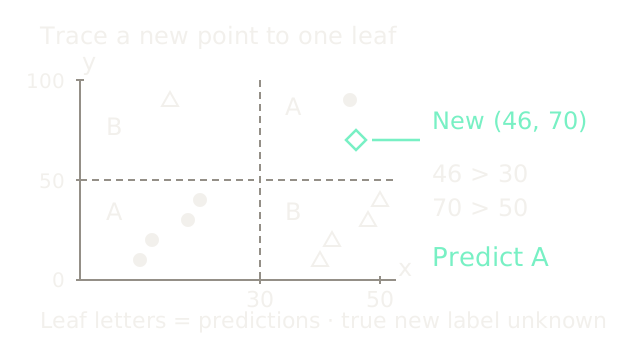
For the illustrative point (46,70), x > 30 chooses the right subtree and y > 50 reaches its A leaf. A is the prediction; the point's true class is unknown. A pure training leaf doesn't establish correctness on unseen samples.
Stop or Split Again
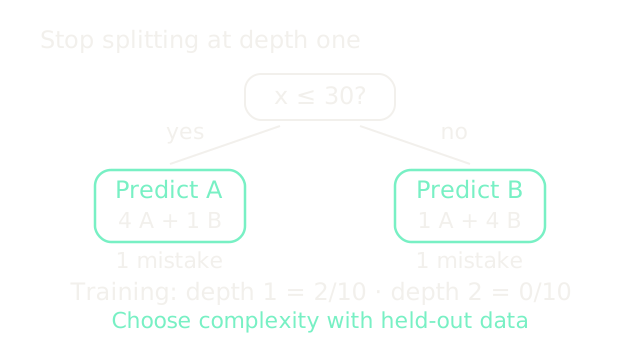
Stopping after the x split predicts each child's majority class and misses one sample per child: 2/10. Depth two fits all ten training labels. Choose depth, leaf-size limits or pruning using held-out evidence; lower training error alone doesn't settle the choice.
Where It Breaks
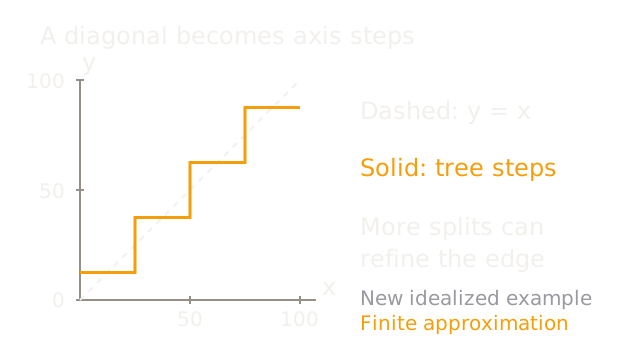
This separate idealized example uses the diagonal boundary y = x. Rectangular leaves form a staircase approximation; more splits can refine it, adding complexity. Useful depth depends on the geometry and tolerated error. Recursive partitioning and its stopping rules define the model; validation determines whether added detail helps.
The Quick Version
- Classification trees follow feature comparisons to a predicted class.
- The x threshold splits this fixture into two five-sample children.
- Weighted Gini falls from 0.50 to 0.32.
- Three split nodes form four leaves at depth two.
- An unseen point's predicted class can differ from its true class.
- Training fit alone doesn't select depth or pruning.
- Axis-aligned leaves approximate diagonals with rectangular steps.